Configuring IP SLA UDP Echo Responder for Voice Traffic
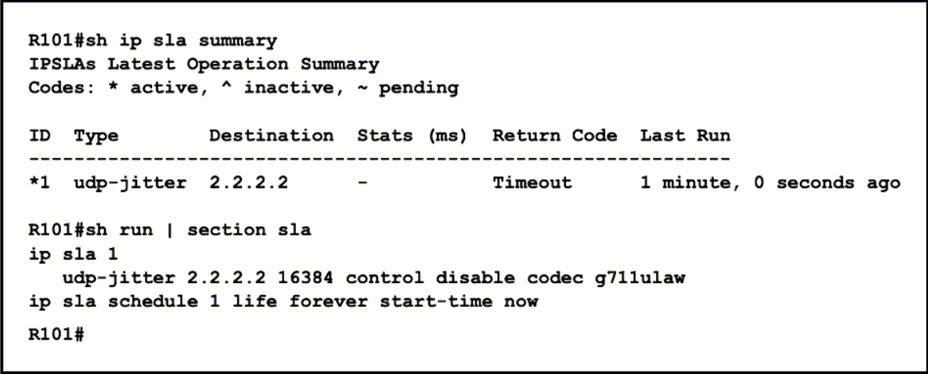
Refer to the exhibit. Jitter on the link between R101 and R201 was tested for voice traffic over port 16384 without the control communication on port 1967. Which command enables R201 to receive RTT for the configured IP SLA? - 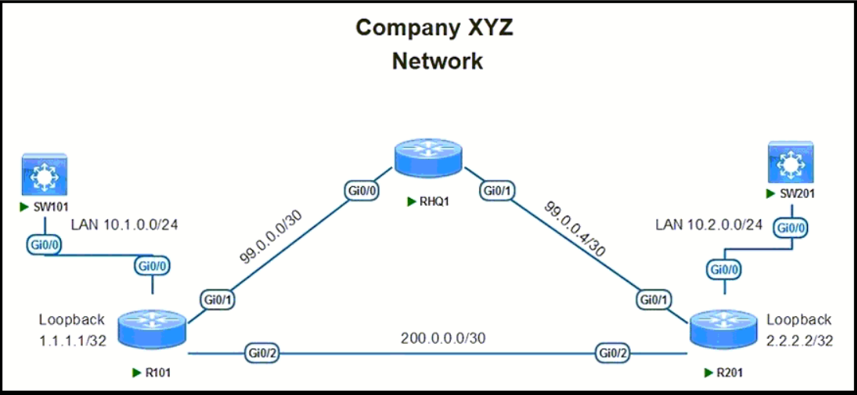 -
- 
Community Votes
100% of anonymous learners picked answer B. Votes are pick records left by other test-takers — they are not the verified answer.
Community Insight
The exam tests whether you know that the 'ip sla responder udp-echo' command requires the IP address of the local interface acting as the responder, not the source IP or an auto-registration method.
This question tests the configuration of Cisco IP SLA responders to measure Round-Trip Time (RTT) for specific UDP voice traffic ports. The correct command must specify the destination router's interface IP and the exact port used by the probe.
Many candidates choose Option C because they mistakenly use the source IP address (1.1.1.1) instead of the destination/responder IP address (2.2.2.2). Others may select D, assuming auto-registration handles all cases without explicit definition.
Community Discussion (4 comments)
Comments & Corrections
No comments yet — spotted an error or have a note? Share it below.
Expert Analysis
Why the Answer Is Correct
Option B is the correct configuration for R201. Since R101 sends a UDP echo probe to port 16384, R201 must be configured withip sla responder udp-echo. Crucially, this command must include the IP address of the interface on R201 that will receive the packet (2.2.2.2) and the port number (16384). This ensures the router explicitly listens on that specific socket for the SLA probe.Why the Other Options Are Wrong
Option A usestcp-connect, but the scenario specifies UDP traffic (voice over UDP), so TCP is incorrect. Option C specifies the source IP (1.1.1.1) instead of the responder's own IP (2.2.2.2); the responder command must bind to its own interface. Option D relies on auto-register, which allows any IP SLA operation to register dynamically, but it does not explicitly define the UDP echo parameters required for this specific voice traffic test, making it less precise than the explicit configuration in B.Community Comment Notes
Community consensus heavily favors Option B. As scarface35 noted, "it should be the IP address of the interface on the destination router-R201 (2.2.2.2)." Another commenter confirmed, "B is correct This command has to be given on the responder," highlighting that the responder side must match the target IP and port. One dissenting comment suggested C, likely confusing the source and destination addresses.Official Reference
Exam Strategy
When configuring IP SLA responders, always remember that the udp-echo command binds to the local interface IP. Check the topology carefully to distinguish between the source IP (where the probe originates) and the destination IP (where the responder sits). For voice/jitter tests, ensure the protocol (UDP) matches the service type.
Frequently Asked Questions
Why can't I use auto-register (Option D)?
Auto-register allows dynamic registration of operations from any source, but it does not explicitly define the UDP echo parameters. Explicit configuration is often required for specific voice traffic probes to ensure correct binding.
What is the difference between tcp-connect and udp-echo?
tcp-connect establishes a TCP connection, while udp-echo sends UDP packets. Voice traffic typically uses UDP, so udp-echo is the appropriate responder type for measuring jitter and RTT on voice ports.
Related Analysis
Practice All 300-410 Questions
Access 159 questions with complete answers and detailed explanations.
View Full 300-410 Practice Test →