How Does R1 Advertise 172.16.2.48/28 into OSPF?
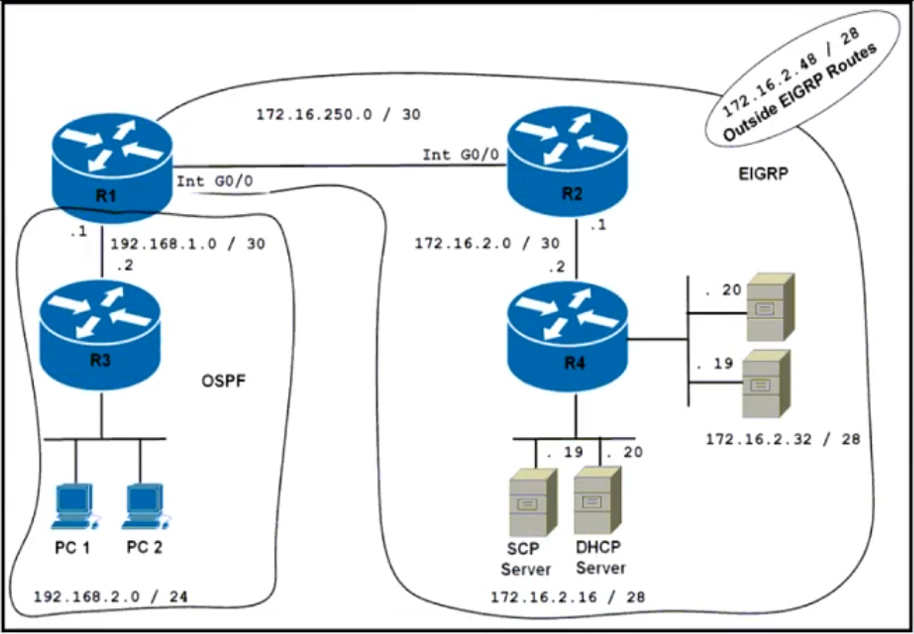
Refer to the exhibit. An engineer must troubleshoot a connectivity issue impacting the redistribution of the subnet 172.16.2.48/28 into the OSPF domain. Which configuration on router R1 advertises this subnet into the OSPF domain? - 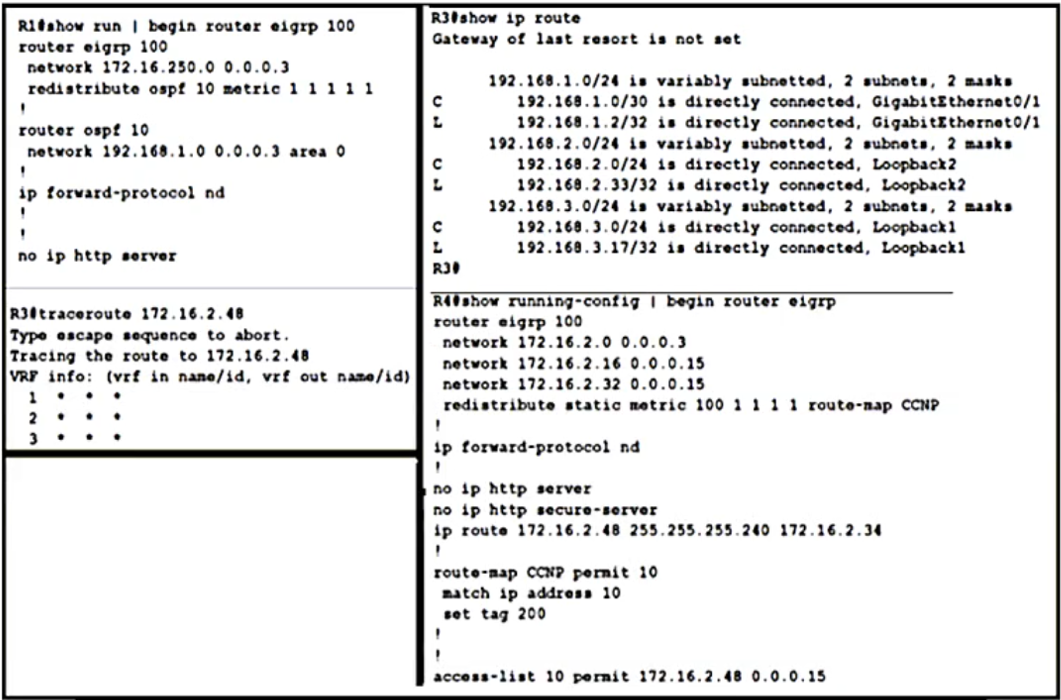 -
- 
Community Votes
75% of anonymous learners picked answer A. Votes are pick records left by other test-takers — they are not the verified answer.
Community Insight
The question tests route-map match/set logic on an EIGRP-to-OSPF redistribution (filtering and tagging) against the trap of a deny entry plus the implicit deny that silently drops any prefix the map does not explicitly permit.
R1 must pull the EIGRP-learned prefix 172.16.2.48/28 — tagged 200 by R4's static route — into the OSPF domain, so the route map chained to the redistribute statement has to match and permit that tag. This page establishes that the correct option is the route-map CCNP permit sequence that selects the tag-200 prefix, not a deny sequence.
Picking the deny variant: a sequence that denies tag 200 filters out the exact /28 that must be advertised, and because every route map ends in an implicit deny, untagged or unmatched prefixes are dropped too — so nothing reaches OSPF.
Community Discussion (5 comments)
Comments & Corrections
No comments yet — spotted an error or have a note? Share it below.
Expert Analysis
Why the Answer Is Correct
R4's static route to 172.16.2.48/28 carries tag 200, and EIGRP propagates that value as an external route attribute, so the tag is still present on R1 when the prefix is considered for OSPF. The route map attached to the redistribution therefore has to permit a route whose tag equals 200, which is precisely what option A'sroute-map CCNP permit 10 sequence does before any other entry. Once that match is permitted, 172.16.2.48/28 is injected into the OSPF domain and connectivity is restored. The community agrees, as bk989 points out: "Look at the R4 static route with a tag of 200." The vote tally (A: 75, B: 25) reflects the same reading of the exhibit.Why the Other Options Are Wrong
Option B usesroute-map CCNP deny 10: a deny entry that matches tag 200 removes the very prefix that must be advertised, and any later permit sequence only catches prefixes the first entry did not match. Pietjeplukgeluk votes B on the theory that the EIGRP external route may not actually be tagged with 200, but the exhibit shows the tag being set on R4's static route to 172.16.2.48/28, which the redistribution preserves. The other permit variants select a different match condition (a different tag, an interface, or a next hop), so the tag-200 prefix fails to match and is discarded by the implicit deny. A route map is a filter, not an advertisement — permitting the wrong identifier still leaves 172.16.2.48/28 out of OSPF.Community Comment Notes
bk989 analyses the exhibit directly: R4's static route is tagged 200 and A is the configuration that permits it, adding that B would only be right if 172.16.2.48 also existed as an untagged external route on R2. Pietjeplukgeluk votes B and warns that "non-tagged routes are dropped due to implict deny in a route-map" — an accurate statement about implicit deny, but one that argues for permitting the tagged prefix rather than denying it. That warning is the reason the match statement must be exact: whichever entry matches tag 200 decides the fate of the /28. The commenter with the tag-200 observation aligns with the exhibited static route tag and the majority vote.Official Reference
Exam Strategy
On any redistribution question, first identify the unique identifier of the prefix you must advertise — here the tag 200 carried from R4's static route — then confirm the route map applied to redistribute explicitly permits that identifier. Always remember the implicit deny at the end of every route map, and never accept a deny entry as the way to 'select' a prefix you actually need.
Frequently Asked Questions
Why would a route-map CCNP deny entry for tag 200 block 172.16.2.48/28 from OSPF?
The prefix inherits tag 200 from R4's static route, so an entry denying tag 200 filters it out; other prefixes then fall through to the implicit deny.
Does R1 need anything besides route-map CCNP to advertise 172.16.2.48/28 into OSPF?
Yes: the map only filters or sets attributes, so redistribute eigrp ... subnets route-map CCNP must exist under router ospf or no EIGRP prefix enters the OSPF domain.
Related Analysis
Practice All 300-410 Questions
Access 159 questions with complete answers and detailed explanations.
View Full 300-410 Practice Test →