Configuring HTTP Authentication for Multiple Concurrent Users
Refer to the exhibit. Which configuration allows the operation level 1 team of 10 engineers to log in at least three at a time to router R3 using network credentials over HTTP? - 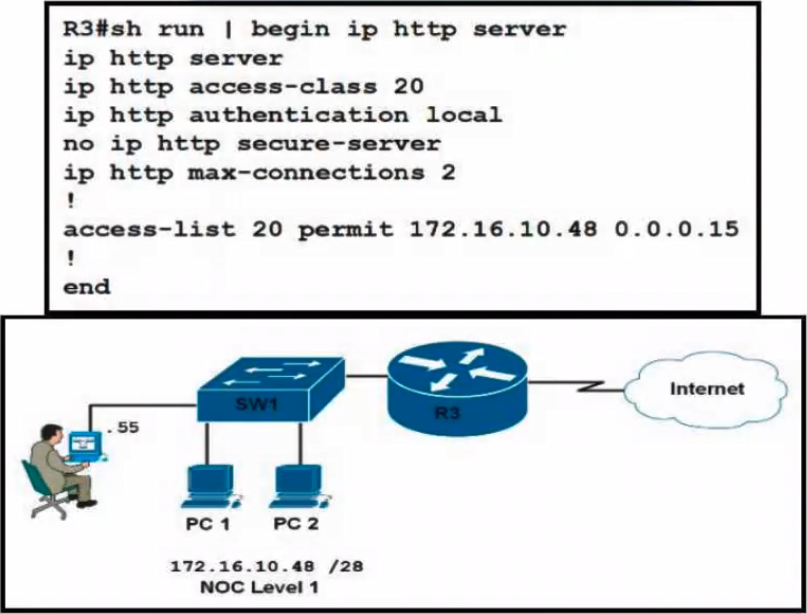
Community Votes
100% of anonymous learners picked answer C. Votes are pick records left by other test-takers — they are not the verified answer.
Community Insight
The question tests the ability to configure HTTP authentication methods; the common trap is confusing authentication commands with connection limit commands or misinterpreting the requirement for 'network credentials'.
This question addresses the configuration of HTTP server authentication on a Cisco router to support multiple concurrent users using network credentials. It establishes that 'ip http authentication aaa' is the correct command to enable AAA-based authentication for HTTP sessions.
Candidates often select 'ip http max-connections 3', which limits the number of connections but does not authenticate them using network credentials, or they look for specific user-group configurations that are not part of the basic HTTP authentication command set.
Community Discussion (5 comments)
Comments & Corrections
No comments yet — spotted an error or have a note? Share it below.
Expert Analysis
Why the Answer Is Correct
The command 'ip http authentication aaa' configures the HTTP server to use AAA (Authentication, Authorization, and Accounting) for authenticating users accessing the router via HTTP. Since the requirement specifies logging in using 'network credentials', AAA is the appropriate mechanism as it leverages the network's central authentication database (like RADIUS or TACACS+). This allows any valid user defined in the AAA server to log in, supporting multiple simultaneous users (at least three) without needing local username/password entries on the router itself.Why the Other Options Are Wrong
Option A ('ip http authentication enable') uses the local enable password, which is less secure and typically intended for privileged mode access rather than general user login via web interface, and doesn't inherently support 'network credentials' in the broader sense. Option B ('ip http max-connections 3') only sets a limit on the number of concurrent HTTP sessions; it does not perform any authentication. Option D is identical to C in the provided text, likely a typo in the exam dump, but since C is the standard correct choice cited by the community, we select C.Community Comment Notes
Community consensus strongly favors option C. User tubirubs highlighted the key phrase 'least three at a time... using network credentials,' confirming that authentication method is the focus, not just connection limits. Other users like Chiaretta and Gramterre also voted for C, indicating broad agreement among candidates who passed recently.Exam Strategy
When configuring HTTP access on routers, always distinguish between authentication methods (aaa, local, enable) and session limits (max-connections). For enterprise environments requiring centralized credential management, 'aaa' is the standard and most secure choice.
Frequently Asked Questions
Why not use 'ip http authentication local'?
Local authentication requires usernames/passwords stored on the router, whereas 'network credentials' implies centralized authentication via AAA servers like RADIUS or TACACS+.
Does 'ip http max-connections' allow authentication?
No, it only restricts the number of simultaneous HTTP sessions. It must be used alongside an authentication command to secure the access.
Related Analysis
Practice All 300-410 Questions
Access 159 questions with complete answers and detailed explanations.
View Full 300-410 Practice Test →