Which BGP Dampening Config Fixes Routes Withdrawn From Peers?
Short answer
A Enable bgp dampening globally under router bgp 100 so flapping BGP-learned networks are suppressed for all peers.
Question
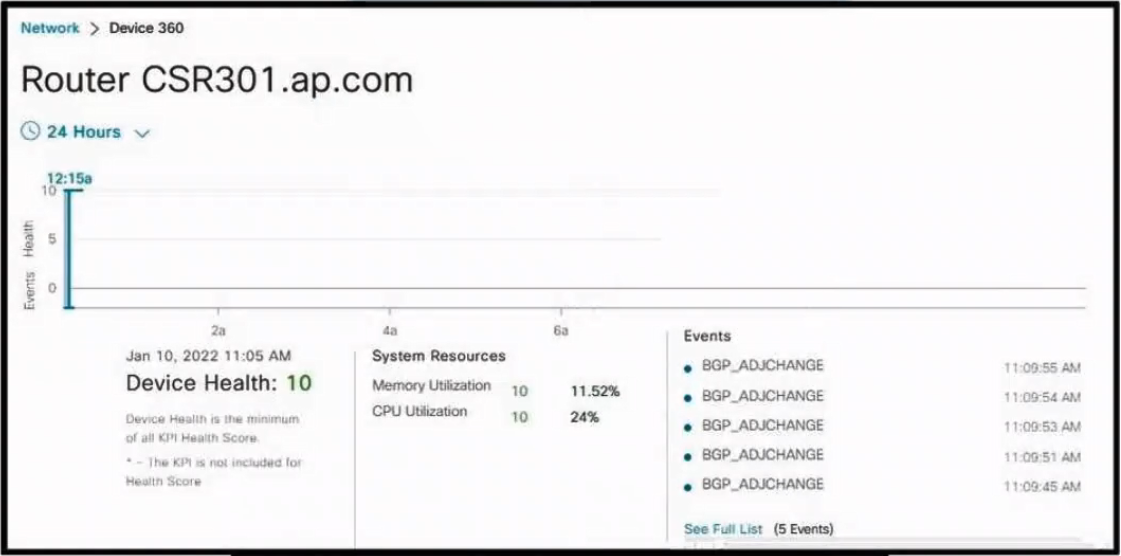 -
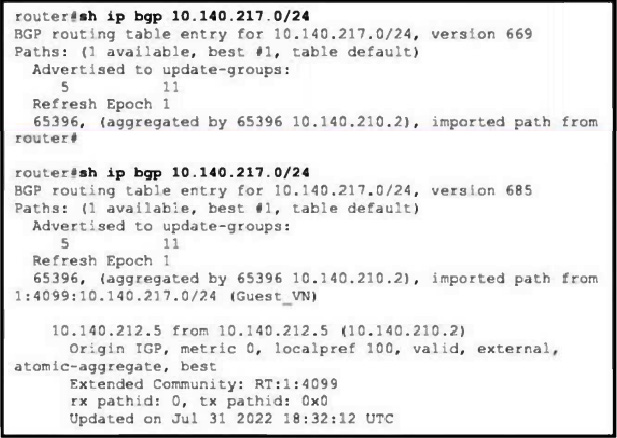
- 
Key Takeaways
The question tests whether you can map the scope word "peers" to a process-wide BGP dampening configuration; the trap is choosing a neighbor-scoped dampening route-map that looks syntactically precise but only fixes one session.
This 300-410 exhibit question asks which configuration stops BGP-learned networks from being repeatedly withdrawn from peers, and the correct answer is the global bgp dampening command under router bgp 100 (A). The route-map Dampening option only dampens routes on a single neighbor, which does not match the plural scope in the stem.
Common mistake: Many candidates pick the route-map Dampening permit 10 option because the neighbor-level dampening syntax looks like a cleaner fix, but that route-map is attached inbound to one neighbor and cannot suppress flapping across every peer described in the question.
Expert Analysis
Why the Answer Is Correct
The stem states that BGP-learned networks are repeatedly withdrawn from peers, meaning the churn is observed across more than one BGP session, not just a single neighbor. Applying the bare "bgp dampening" command inside "router bgp 100" (option A) enables route dampening for the whole BGP process, so any flapping prefix received from those peers is suppressed after it crosses the suppress threshold instead of being continually re-advertised and withdrawn. The command also takes the default half-life, reuse, suppress and max-suppress values, so no extra parameters are required to make the configuration complete. The first exhibit shows exactly this global placement, while the second exhibit shows the neighbor-scoped alternative, making scope the deciding factor.Why the Other Options Are Wrong
Option D uses "route-map Dampening permit 10" with a set dampening action attached to a specific neighbor, so it only affects the routes learned from that one session and leaves the other flapping peers untouched. Option C shows the same route-map construct and fails for the same reason: the stem talks about peers plural, and a single-neighbor remedy does not satisfy that scope. Option B, the second "router bgp 100" entry in the exhibit, does not match the global dampening behavior demonstrated for A and is not the configuration that suppresses flapping process-wide. Even the vote minority for D focused on syntax from a single-neighbor example rather than on the multi-peer wording, which is why the route-map variants lose.Community Comment Notes
Most commenters chose A. As wwwwaaaa reasoned, A fits "just because of 'from peers' so not a single peer/route", implying the fix must be global rather than per-neighbor. NazgulNr5 echoed that the question says the problem occurs with 'peers' and noted that D "only applies to one neighbor", which is precisely the limitation the stem rules out. dapardo still preferred D and referenced a BGP route-dampening example, while Sammy3637 argued that the router bgp 100 variant is "close but incomplete" without threshold parameters. Despite that dissent, the thread converges on A because the exhibit's global dampening placement matches a multi-peer flapping scenario.Official Reference
This link opens the official vendor documentation in a new tab.
Exam Strategy
When a BGP stem uses a plural scope word such as "peers", immediately eliminate any option that is attached to one specific neighbor and look for the command that enables the feature process-wide under router bgp. On exhibit questions, compare where the configuration is applied (router bgp versus neighbor) before comparing the damping parameters themselves.
Frequently Asked Questions
Why is a neighbor route-map with set dampening wrong for flapping peers?
Does the bare 'bgp dampening' command need half-life and suppress thresholds?
Community Votes
73% of anonymous learners picked answer A. Votes are pick records left by other test-takers — they are not the verified answer.
Discussion 8 contributions
Compiled from public community threads and reader submissions, lightly edited for clarity. Handles and vote tallies are shown as recorded, and comments reflect the views of individual contributors.
From public community threads 8
-
wwwwaaaa 👍 3 Answered AI will go with "A" just because of "from peers" so not a single peer/route plus, while "D" has the config correct, but we dont know if that flapping happening only on that one single neighbor
-
NazgulNr5 👍 3 Answered AI say A because the question states the BGP problems occur with 'peers' not just one peer and D only applies to one neighbor.
-
dapardo 👍 2 Answered DI agree with D, configuration seems to be right. Check this example: https://networklessons.com/bgp/bgp-route-dampening
-
Pietjeplukgeluk 👍 2 Answered AJust because my other comment i will go for A (reasoning see other comment)
-
Sammy3637 👍 2 Answered AAgree ! As it specifically asks for 'peers'
Show 3 more comments
-
tsamoko 👍 1 Answered A100% A . Check the following links : 1) https://networklessons.com/bgp/bgp-route-dampening 2) https://www.cisco.com/c/en/us/td/docs/ios-xml/ios/iproute_bgp/configuration/15-mt/irg-15-mt-book/irg-int-features.html#GUID-9CC2C114-3632-4D1D-9C92-8A1E4DF59061 3) https://networkengineering.stackexchange.com/questions/72994/change-bgp-dampening-parameters-for-a-specific-neighbor 4) https://networkengineering.stackexchange.com/questions/72994/change-bgp-dampening-parameters-for-a-specific-neighbor Furthermore , tested in GNS3 . A works fine . Tried to configure D , error shown "% "Dampening" used as BGP inbound route-map, set dampening not supported"
-
leipeG 👍 1The correct answer is D because the issue in the question describes BGP routes being "repeatedly withdrawn." This typically indicates route flapping, where routes are constantly being advertised and withdrawn due to instability. BGP route dampening is used to reduce the impact of such instability by suppressing routes that are frequently flapping. Neighbor route-map Dampening in: The key here is applying the dampening "in", which applies it to the incoming routes from the neighbor. This helps prevent the local router from flapping routes and constantly withdrawing them from the peers.
-
Sammy3637 👍 1 Answered DThe command router bgp 100 bgp dampening is close but incomplete. To properly configure BGP dampening, you need to include the specific parameters for half-life, reuse-threshold, suppress-threshold, and max-suppress-time.
Reader comments & corrections
No reader corrections yet — spotted an error or have a note? Share it below.
Related Analysis
Practice All 300-410 Questions
Access 159 questions with complete answers and detailed explanations.
View Full 300-410 Practice Test →