OSPF Area Configuration for Path Selection
Short answer
B Configure R1 and R2 links under area 1 to make the direct path an intra-area route, which OSPF prefers over inter-area alternatives.
Question
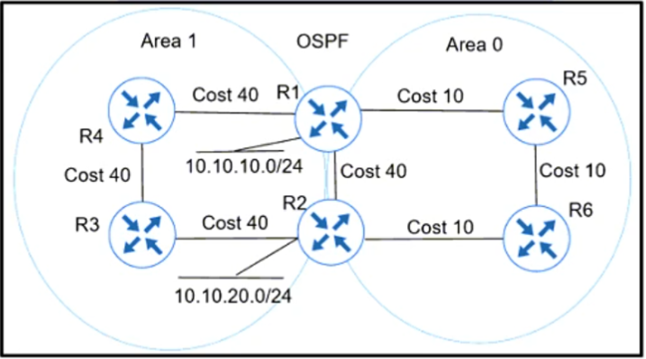
Refer to the exhibit. Which action ensures that 10.10.10.0/24 reaches 10.10.20.0/24 through the direct link between R1 and R2?
Key Takeaways
OSPF selects routes based on area scope first; a lower-cost inter-area route never beats a higher-cost intra-area route, so area membership must match for direct connectivity.
Learn why OSPF prefers intra-area routes and how assigning a link to the correct area ensures traffic follows the desired direct path between routers.
Common mistake: Choosing to configure OSPF path cost (C or D) is incorrect because OSPF always prefers intra-area routes over inter-area routes regardless of the metric difference.
Expert Analysis
The question asks how to force traffic from network 10.10.10.0/24 (on R1) to reach 10.10.20.0/24 via the direct link between R1 and R2. The exhibit shows that the direct link is in Area 0, while both source and destination networks are in Area 1. This means the path through the backbone (R1-R2) is an inter-area route (O IA), whereas the path via R3/R4 is likely an intra-area route (O). OSPF strictly prefers intra-area routes over inter-area routes regardless of metric, so changing costs on the Area 0 link will not override this preference.
To ensure the direct link is used, it must be treated as an intra-area route. Since the endpoints are in Area 1, the link connecting them must also be assigned to Area 1. By configuring the R1-R2 link under Area 1 (Option B), the route becomes intra-area, making it preferred over any other inter-area or external paths. Comments correctly highlight that OSPF path selection logic prioritizes area type before metric; thus, simply lowering the cost (Options C and D) fails because the 'wrong' area path remains superior by default rules.
Exam Strategy
When troubleshooting OSPF path selection, always evaluate the LSA type and area origin before looking at metrics. If the desired path uses a different area than the destinations, it will be classified as inter-area (Type 3) and lose to intra-area (Type 1) routes. To force a specific hop, ensure the transit link shares the same area as the endpoints.
Frequently Asked Questions
Why doesn't lowering the OSPF cost on the direct link work?
What happens if I put the direct link in Area 1?
Community Votes
67% of anonymous learners picked answer C. Votes are pick records left by other test-takers — they are not the verified answer.
Discussion 9 contributions
Compiled from public community threads and reader submissions, lightly edited for clarity. Handles and vote tallies are shown as recorded, and comments reflect the views of individual contributors.
From public community threads 9
-
ellen_AA 👍 27 Answered BBoth given routes are in area1, direct link is in area0. By default ospf prefers intra-area routes 'O' over inter-area routes 'O IA'. Bringing the direct link to the same area as both routes will make it preferable.
-
HungarianDish_111 👍 7Great solution! Well explained! https://networklessons.com/ospf/ospf-path-selection-explained OSPF will first look at the “type of path” to make a decision and, secondly look at the metric (cost).
-
dapardo 👍 3very tricky, I dont even noticed that the link was part of Area 1! thanks, Agree its B
-
leooooo 👍 2answer is B. it is because 10.10.20.0/24 is advertised via area 1. in r1 perspective,it have both type 3 LSA inter-area route advertised by R2 and intra-area route computed by type 1 LSA. R1 will choose intra area route so that traffic will go to R4 instead of R1 no matter what cost is the direct link of area 0.
-
f23ff88 👍 1 Answered Ci agree. what Ellen says is correct but when we compare 2 routes an intra area route with an interarea route. as far as i can see in the excibit, there is not such a case. we have 2 intrarea routes one with cost 40 and the second with cost 30. so i believe c is correct.
Show 4 more comments
-
smayus 👍 1How do we know if they are not in the same area 1 for sure? Wouldn't that be easier to configure cost to 3 for example?
-
GReddy2323 👍 1Thank you for your detailed answer.
-
abd123 👍 1why not C , please advise
-
Mario73 👍 1 Answered CThe correct answer is C
Reader comments & corrections
No reader corrections yet — spotted an error or have a note? Share it below.
Related Analysis
Practice All 300-410 Questions
Access 159 questions with complete answers and detailed explanations.
View Full 300-410 Practice Test →