EIGRP Feasible Successor Path Bandwidth Tuning
Short answer
C Increase path bandwidth higher than 10.1.2.2 and lower than 10.1.1.2 between RtrA and the destination.
Question
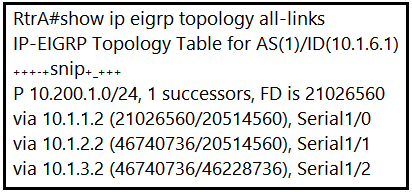
Refer to the exhibit. Which action makes 10.1.3.2 the feasible successor to reach 10.200.1.0/24 for location S42T431E64F51?
Key Takeaways
This question tests the EIGRP feasibility condition, where a route's reported distance must be lower than the successor's feasible distance, but its total metric must remain higher to avoid becoming the successor.
To make an EIGRP route a feasible successor without making it the successor, its path bandwidth must be tuned to meet the feasibility condition while keeping its total metric worse than the current successor.
Common mistake: Option D is wrong because increasing the bandwidth higher than both 10.1.2.2 and 10.1.1.2 makes the route the successor, not the feasible successor.
Expert Analysis
The Feasibility Condition Trap
In EIGRP, a route is only installed as a feasible successor if its Reported Distance (RD) is strictly less than the Feasible Distance (FD) of the current successor route. Option D is highly attractive because increasing the path bandwidth for 10.1.3.2 higher than both 10.1.1.2 and 10.1.2.2 guarantees the metric will be excellent, easily satisfying the feasibility condition. However, this is exactly where Option D fails the question's requirements. By making the bandwidth higher than the current successor (10.1.1.2), the total metric (FD) for 10.1.3.2 will drop below that of 10.1.1.2. EIGRP will then select 10.1.3.2 as the new successor, displacing 10.1.1.2, which directly violates the question's mandate to make it the feasible successor.
Why Option C is Correct
To remain a feasible successor, 10.1.3.2 must satisfy the feasibility condition without having a better metric than the successor. Option C specifies increasing the path bandwidth higher than 10.1.2.2 but lower than 10.1.1.2. This specific tuning improves the metric of 10.1.3.2 enough to lower its RD below the FD of 10.1.1.2 (meeting the feasibility condition), but because the bandwidth is kept lower than 10.1.1.2, its overall FD remains worse than the successor's FD. Thus, 10.1.1.2 remains the successor, and 10.1.3.2 becomes the feasible successor.
Practical EIGRP Tuning
As noted in community discussions, while bandwidth is used in this question's options, Cisco best practice for influencing EIGRP path selection is to use delay. Modifying bandwidth can have unintended consequences on other routing protocols or EIGRP calculations that rely on the interface bandwidth. Nonetheless, based on the provided options, adjusting the bandwidth to sit between the two existing paths is the only way to achieve the desired feasible successor state.
Official Reference
This link opens the official vendor documentation in a new tab.
Exam Strategy
When asked to make an EIGRP route a feasible successor, remember the rule: RD < FD(successor) but FD(route) > FD(successor). Avoid options that make the route's metric better than the current successor, as those will incorrectly make it the successor.
Community Votes
90% of anonymous learners picked answer C. Votes are pick records left by other test-takers — they are not the verified answer.
Discussion 11 contributions
Compiled from public community threads and reader submissions, lightly edited for clarity. Handles and vote tallies are shown as recorded, and comments reflect the views of individual contributors.
From public community threads 11
-
ccnptoppler34 👍 20 Answered CI don't believe D is correct the question asks to make the the route to 10.1.3.2 the feasible successor not the successor
-
HungarianDish_111 👍 5 Answered CCorrect is "C". https://networklessons.com/eigrp/eigrp-wide-metrics Further info: https://www.cisco.com/c/en/us/support/docs/ip/enhanced-interior-gateway-routing-protocol-eigrp/16406-eigrp-toc.html If it is necessary to influence the path EIGRP chooses, always use delay to do so. https://www.cisco.com/c/en/us/support/docs/ip/enhanced-interior-gateway-routing-protocol-eigrp/13673-14.html There are two reasons you must not to use the bandwidth to influence EIGRP paths: -If you change the bandwidth it can have impact beyond the effect to the EIGRP metrics. -When you lower the bandwidth it can prevent EIGRP neighbors that get hello packets because it throttles back. If you change the delay it does not impact other protocols nor does it cause EIGRP to throttle back.
-
pyrokar 👍 4 Answered C10.1.3.2 can't be the feasible successor since feasibility condition is not met. Apart from that, it should be C.
-
toto89 👍 3 Answered CI also think C is the right answer, minimum path bandwidth lower than 10.1.1.2 and higher than 10.1.2.2 should do it. But again a weird question from Cisco, we don't know anything about the cumulative delay and other parameters such as the number of hops between the local router and the destination for each path. B could also do it since all we want here is meeting the feasibility condition for the 10.1.3.2 path. But C is the more likely to be true.
-
sayed_2908 👍 3 Answered CD will make 10.1.3.2 the successor and we don't want that.
Show 6 more comments
-
forccnp 👍 3 Answered CD will make 10.1.3.2 the successor
-
inteldarvid 👍 2 Answered Cyesy optio c correct
-
Titini 👍 2 Answered CAnswer is C
-
XxnightwingxX 👍 1 Answered Cbad formatting on this question. Also, why is Cisco still forcing EIGRP on test takers? OSPF and BGP in the real world.
-
bk989 👍 1EXACTLY WHAT I WAS THINKING, BUT I WILL GO WITH c
-
Mario73 👍 1 Answered DThe correct answer in this scenario is D.
Reader comments & corrections
No reader corrections yet — spotted an error or have a note? Share it below.
Related Analysis
Practice All 300-410 Questions
Access 159 questions with complete answers and detailed explanations.
View Full 300-410 Practice Test →