What Does 10.0.1.3/32 Represent in the Routing Table?
Short answer
B The 10.0.1.3/32 entry is a host route that matches only the single destination address 10.0.1.3.
Question
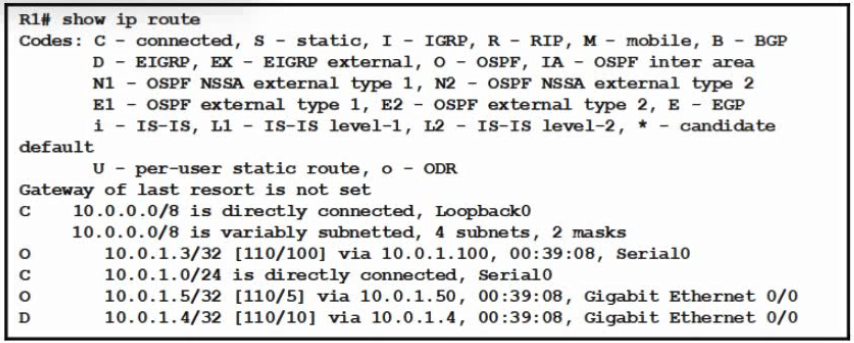
Refer to the exhibit. What does route 10.0.1.3/32 represent in the routing table?
Key Takeaways
This question tests whether you read the /32 prefix length as a single-host match and avoid confusing a destination route with a source address or a broader subnet.
The 10.0.1.3/32 routing-table entry is a host route, and this page explains why it matches one destination address rather than a subnet, source, or network.
Common mistake: A common mistake is choosing A, assuming the 10.0.1.x entry covers all hosts in the 10.0.1.0 subnet; however, /32 masks every bit, so only 10.0.1.3 is matched.
Expert Analysis
Prefix length is the deciding field. In an IPv4 routing table, each entry pairs a destination prefix with a prefix length. The entry 10.0.1.3/32 has all 32 bits fixed: its mask is 255.255.255.255, so there are no remaining host bits to vary. That makes it a host route. It matches exactly one destination address, 10.0.1.3, and nothing else. This is the principle behind option B.
Routing tables describe destinations, not sources. A route entry is consulted for the destination IP address in a packet header. It does not identify the sender. Therefore 10.0.1.100 in option C cannot be what the route represents merely because it appears in the same exhibit or subnet. The route is not pointing back to a source address; it is a destination match. Option D is also too broad: 10.0.0.0 would be a different network prefix, and the displayed entry is not that aggregate. Option A describes a subnet range, but a /32 does not cover all hosts in 10.0.1.0/24; that would require a shorter prefix such as /24.
Longest prefix match confirms the role. If a packet is destined to 10.0.1.3, this /32 entry is the most specific possible match and wins over any less-specific route such as 10.0.1.0/24 or a default route. If the packet is destined to 10.0.1.4, the /32 route does not match at all. The commentary on this item makes the same point: a /32 is treated as a host-based route pointing to one IP address, not an entire subnet or network.
Cisco local-route angle. In Cisco IOS output, a /32 can appear as a local route associated with an interface address, but the forwarding meaning is unchanged: the prefix identifies a single destination address. The correct choice is B, "a single destination address."
Exam Strategy
When a routing-table question shows a prefix, inspect the prefix length before anything else: /32 is one host, /24 is a subnet, and /0 is a default route. Then ask whether the entry is being used to match a packet's destination, because routing tables do not select routes by source address. Finally, apply longest-prefix-match logic: a /32 host route beats a broader connected or static route for that exact address.
Frequently Asked Questions
Why is 10.0.1.3/32 called a host route?
Does a /32 route match 10.0.1.100 in the same subnet?
Is a /32 route always a static route?
Community Votes
100% of anonymous learners picked answer B. Votes are pick records left by other test-takers — they are not the verified answer.
Discussion 3 contributions
Compiled from public community threads and reader submissions, lightly edited for clarity. Handles and vote tallies are shown as recorded, and comments reflect the views of individual contributors.
From public community threads 3
-
Shaifalimittal02 👍 3 Answered BThe route 10.0.1.3/32 represents a single host route, as the /32 prefix length specifies a single IP address. In this case, it is an exact match to the IP address 10.0.1.3. Therefore, it points to a single destination address rather than an entire subnet or network.
-
MinSun600 👍 1 Answered BIt’s serial with /32 prefix length specifies a single IP address it points to single destination address
-
maximus_007 👍 1 Answered B/32 is considered a host based route so given answer is correct.
Reader comments & corrections
No reader corrections yet — spotted an error or have a note? Share it below.
Related Analysis
Practice All 200-301 Questions
Access 220 questions with complete answers and detailed explanations.
View Full 200-301 Practice Test →