Router Behavior for Unroutable Packets Without Default Route
Short answer
D The router discards the packets because the destination 10.10.10.16 falls outside the connected /28 subnet range and no default route exists to forward the traffic.
Question
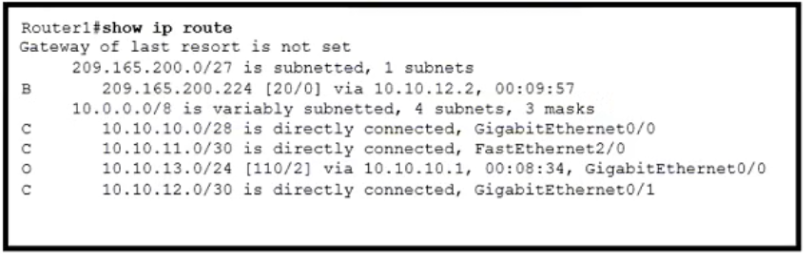
Refer to the exhibit. Which action is taken by the router when a packet is sourced from 10.10.10.2 and destined for 10.10.10.16?
Key Takeaways
The trap is assuming the router will try to forward to a similar route or flood; the key is recognizing that without a matching specific route or a default route, the packet must be dropped.
This question tests understanding of IPv4 subnetting limits and routing table lookups. When a destination IP like 10.10.10.16 lies outside the directly connected subnet and no default gateway is present, the router discards the packet.
Common mistake: Option B is the most plausible wrong answer. Candidates may think the router uses a 'similar' route or assumes a default route exists implicitly. However, without an explicit default route (0.0.0.0/0), the router has no instruction to send the packet elsewhere.
Expert Analysis
The question hinges on the specific subnetting of the destination address relative to the router's configured interfaces. The exhibit (implied by comments) shows an interface with IP 10.10.10.1/28. A /28 mask (255.255.255.240) creates a block size of 16. For the 10.10.10.0 network, the valid host range is 10.10.10.1 to 10.10.10.14, with 10.10.10.15 as the broadcast address. The next subnet begins at 10.10.10.16.
The packet is destined for 10.10.10.16. Since this address is the network ID of the next subnet and not part of the directly connected 10.10.10.0/28 network, the router performs a longest prefix match lookup. It finds no specific route for 10.10.10.16/28 or any other more specific route. Crucially, there is no default route (gateway of last resort) configured, as noted in the comments: "default gateway is not set." Without a default route, the router cannot forward packets to unknown networks. Therefore, it discards the packet and typically sends an ICMP Destination Unreachable message back to the source.
Option A is incorrect because flooding occurs only within a VLAN for unknown unicast traffic, not during routing decisions across subnets. Option B is misleading; while a summary route might match, none exists here, and even if it did, the lack of a default route makes 'discarding' the primary outcome for an unroutable destination in this context. Option C is incorrect because routers do not queue packets indefinitely waiting for routes; they drop them if no path exists.
Exam Strategy
Always verify the exact subnet range of connected interfaces before making forwarding decisions. If the destination IP is not in a connected subnet, check for a default route. If no default route exists, the correct action is almost always to discard the packet.
Frequently Asked Questions
What happens if a default route was configured?
Is 10.10.10.16 a broadcast address?
Community Votes
80% of anonymous learners picked answer D. Votes are pick records left by other test-takers — they are not the verified answer.
Discussion 8 contributions
Compiled from public community threads and reader submissions, lightly edited for clarity. Handles and vote tallies are shown as recorded, and comments reflect the views of individual contributors.
From public community threads 8
-
RidzV 👍 15 Answered DAnswer is correct. 10.10.10.16 is not in the defined subnet range I.e. 10.10.10.0/28 and since default gateway is not set, packets to the undefined destination address will be dropped.
-
enzo86 👍 5correct. is D.
-
ac89l 👍 2my bad, the answer is D
-
maximus_007 👍 1 Answered DThe 10.10.10.16 IP falls outside of the /28 range of usable IP's and with no gateway of last resort present, the packet will get dropped.
-
7a136f6 👍 1 Answered Danswer is correct. source and destination belong to the same subnet, so source end host should have sent it directly
Show 3 more comments
-
PaddyInNZ 👍 1Easy way to remember is that all broadcast addresses are an odd number. As .16 isn't odd, it can't be a B/C.
-
Lse 👍 1 Answered D10.10.10.0/28 seems almost valid :) range 0-15 10.10.10.16 is out of range, no valid route
-
ac89l 👍 1 Answered BThis is broadcast address, and it will be routed to closest route matching the subnet.
Reader comments & corrections
No reader corrections yet — spotted an error or have a note? Share it below.
Related Analysis
Practice All 200-301 Questions
Access 220 questions with complete answers and detailed explanations.
View Full 200-301 Practice Test →