Identifying EIGRP Next-Hop IP Addresses
Short answer
B The next-hop IP address for R2 is 10.10.10.6, representing the interface of the neighboring router R3 towards the application server.
Question
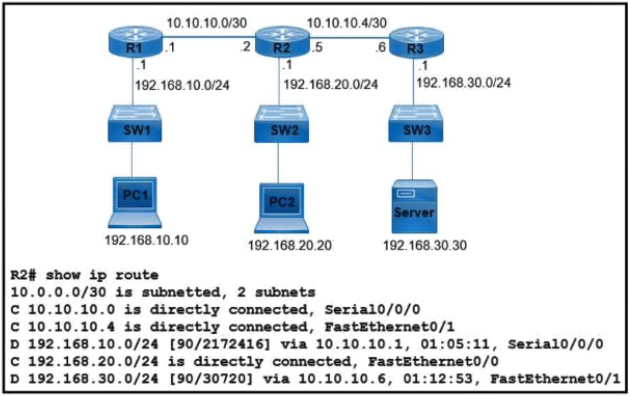
Refer to the exhibit. What is the next-hop IP address for R2 so that PC2 reaches the application server via EIGRP?
Key Takeaways
The main trap is confusing the destination gateway (Option A) with the immediate next-hop router interface (Option B); the next-hop is always the adjacent router's IP on the shared link.
Determine the correct next-hop IP for Router 2 in an EIGRP topology to reach a remote server. The correct answer is 10.10.10.6.
Common mistake: Option A (192.168.30.1) is often chosen incorrectly because candidates mistake the destination network's gateway or the server's IP for the immediate next-hop router interface.
Expert Analysis
Analyzing the Next-Hop Perspective
The core of this question is understanding how routing tables are populated and interpreted. The question asks for the next-hop IP address for R2 (Router 2). In a routing table entry, the 'next-hop' is the immediate neighbor to which the router forwards packets destined for a specific remote network.
Why Option A is Misleading
Option A (192.168.30.1) is the most attractive wrong answer because it represents the destination network's gateway or the server itself. Many candidates mistakenly identify the final destination or the egress interface address as the next hop. However, R2 does not know how to reach 192.168.30.1 directly; it must first send the packet to its own upstream neighbor. Choosing this option confuses the destination with the forwarding target.
Determining the Correct Neighbor
Based on standard topological conventions in such exhibits where PC2 connects to R2, and assuming R2 is connected to R3 via a point-to-point link:
- PC2 sends traffic to R2's local interface.
- R2 looks up the route to the application server network (likely 192.168.30.0/24 or similar).
- R2 forwards the packet to its egress neighbor, R3.
- The IP address of the interface on R3 that belongs to the shared segment with R2 is the next-hop address.
Commenters correctly note that 10.10.10.6 is the address of Router 3. Since R2 must forward traffic towards the server via R3, 10.10.10.6 is the correct next-hop IP for R2's routing decision. Option B aligns with this logical forwarding path.
Exam Strategy
When asked for the 'next-hop', always look at the specific router mentioned in the question. Identify its egress interface towards the destination network and select the IP address of the neighbor router on that link, not the destination IP or the source IP. Visualize the packet flow: Source -> Local Router -> Next-Hop Neighbor -> ... -> Destination.
Frequently Asked Questions
What is the difference between a next-hop and a default gateway?
How do I identify the next-hop in a router exhibit?
Community Votes
67% of anonymous learners picked answer B. Votes are pick records left by other test-takers — they are not the verified answer.
Discussion 5 contributions
Compiled from public community threads and reader submissions, lightly edited for clarity. Handles and vote tallies are shown as recorded, and comments reflect the views of individual contributors.
From public community threads 5
-
studying_1 👍 5 Answered BAnswer is correct, 192.168.30.0/24 via 10.10.10.6
-
blu3wr 👍 2 Answered D192.168.20.1 is gateway in R2 for PC2
-
DarthFrank 👍 1It wants to the know the NEXT HOP IP for Router 2 which would be 10.10.10.6 which is Router 3. The 192.168.20.1 is the next hop for the PC and on the inside interface of Router 2. We want the next hop for the ROUTER, NOT the PC.
-
maximus_007 👍 1 Answered BB would be the next hop which would then route to the server.
-
tattybizzy 👍 1B is correct
Reader comments & corrections
No reader corrections yet — spotted an error or have a note? Share it below.
Related Analysis
Practice All 200-301 Questions
Access 220 questions with complete answers and detailed explanations.
View Full 200-301 Practice Test →