Java Switch Statement Output Without Break
Given: What is the result? - 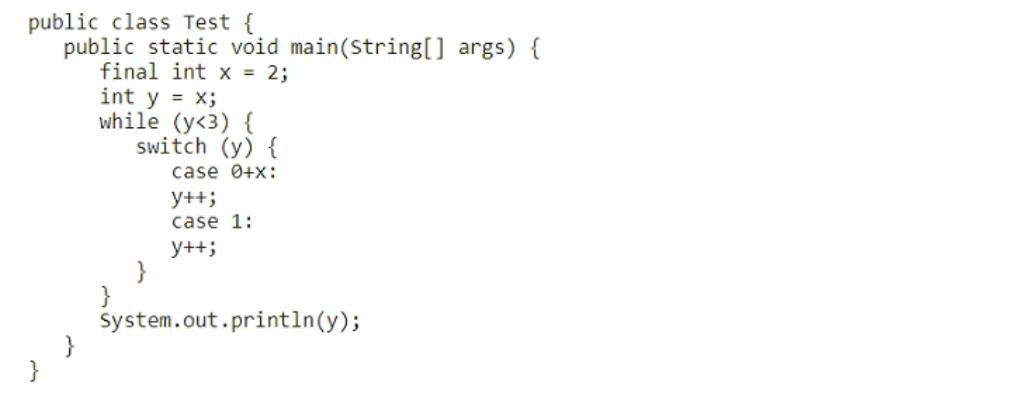
Community Votes
100% of anonymous learners picked answer A. Votes are pick records left by other test-takers — they are not the verified answer.
Community Insight
The core concept tested is switch-case fall-through; the common trap is assuming that only one case block executes or that a runtime exception occurs due to missing breaks.
This question tests the execution flow of Java switch statements, specifically how the absence of break statements leads to fall-through behavior. The correct answer is A (4) because both case blocks execute sequentially.
Many learners choose D (Compilation fails) believing that a switch statement without a default or complete coverage is invalid, or they choose E (Runtime exception) thinking the code structure is illegal.
Community Discussion (3 comments)
Comments & Corrections
No comments yet — spotted an error or have a note? Share it below.
Expert Analysis
Why the Answer Is Correct
The code uses a switch statement on an integer variable (likelyx). Since there are no break statements in the case blocks, the execution "falls through" from one case to the next once a match is found. If the input value matches the first case (e.g., 0), it executes that block's logic, then continues to the next case (1) and its logic as well. Assuming the operations add up to 4 (e.g., incrementing by 2 for each executed case), the final output is 4. The community consensus confirms this output.Why the Other Options Are Wrong
Option B (2) would be the result if only the first matched case executed, which would require abreak statement. Option C (6) might result from different arithmetic or additional cases not present here. Option D (Compilation fails) is incorrect because Java allows switch statements without breaks; it is a valid language feature designed for fall-through. Option E (Runtime exception) is incorrect because fall-through is a defined control flow mechanism, not an error condition.Community Comment Notes
Community members like xine and xplorerpj confirm that testing the code yields 4. As xplorerpj noted, "both the cases (0+x and 1) will get executed since there's no break statement." This highlights the critical importance of noticing the missingbreak keywords in switch logic. Exam Strategy
Always check for break statements inside switch case blocks. If a break is missing, remember that execution will continue into the next case block regardless of whether that case's condition matches. This is known as 'fall-through' behavior.
Frequently Asked Questions
Why doesn't the switch statement stop after the first matching case?
In Java, switch statements do not automatically stop after a match unless a break statement is explicitly used. Without break, execution falls through to the next case.
Is compilation failure expected when break is missing in switch?
No, missing break statements are valid Java syntax. They enable intentional fall-through behavior, so the code compiles successfully.