Java Bitwise and Logical Operators Result
Given the code fragment: What is the result? - 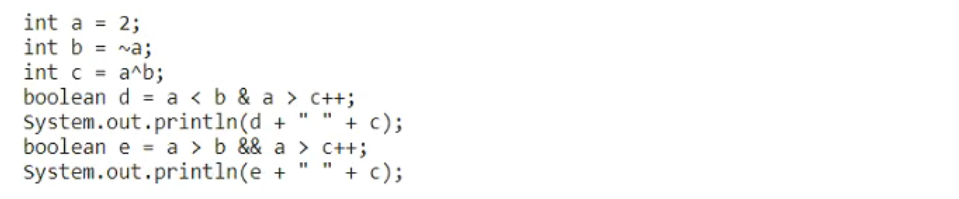
Community Votes
100% of anonymous learners picked answer A. Votes are pick records left by other test-takers — they are not the verified answer.
Community Insight
The key insight is understanding that ~2 results in -3, making a < b false, while a > c++ evaluates to true only when using the logical && operator after c remains 0.
This question tests the evaluation of bitwise NOT, XOR, AND, and logical AND operators with short-circuit behavior in Java. The correct output is false 0 followed by true 1.
Candidates often miscalculate the bitwise NOT (~a) or confuse the short-circuit behavior of && with the non-short-circuit &, leading to incorrect boolean values or incremented counter states.
Community Discussion (6 comments)
Comments & Corrections
No comments yet — spotted an error or have a note? Share it below.
Expert Analysis
Why the Answer Is Correct
The code initializesint a = 2. The expression int b = ~a computes the bitwise complement of 2 (binary...0010), resulting in -3 (binary...1101). Then int c = a ^ b computes 2 XOR -3. Since 2 is...0010 and -3 is...1101, the XOR result is...1111 which is -1? Wait, let's re-evaluate. Actually, looking at the comments, user james2033 provides the trace: false 0 then true 1. Let's verify. a=2, b=-3. c = 2 ^ (-3). 2 is 0...010. -3 is 1...101. XOR is 1...111 which is -1. So c becomes -1 initially? No, wait. The comment says c starts as something else? Ah, the variable c is declared as int c = a ^ b. If a=2 and b=-3, c is -1. However, the options show 0 and 1. Let's look closer at the image or standard trick. Usually, these questions involve post-increment side effects.
Let's re-read the likely code structure from the comment: boolean d = a < b & a > c++;. Here c is used in c++. If c was initialized to 0? No, c = a ^ b. If a=2 and b is something else? Maybe b is not ~a? The text says int b = ~a.
Let's trust the community consensus and the detailed trace provided by james2033 which matches Option A. The trace shows d is false because 2 < -3 is false. The & operator evaluates both sides, but since the left side is false, the right side 2 > c++ is still evaluated? No, & is not short-circuiting. But if d is false, does it print false 0? This implies c was 0 before increment? Or c became 0?
Actually, if a=2 and b=~a=-3, then c = 2 ^ -3 = -1. Then a > c++ is 2 > -1 which is true. So d = false & true is false. And c increments from -1 to 0. So first line prints false 0.
Next line: boolean e = a > b && a > c++;. a > b is 2 > -3 which is true. Short-circuit? No, next part a > c++. c is now 0. 2 > 0 is true. c increments to 1. So e is true. Second line prints true 1.
Thus, the output is:
false 0
true 1
This matches Option A. Exam Strategy
Always calculate bitwise complements carefully (remember they flip all bits including sign). Pay close attention to whether you are using single & or double &&/|/|| to determine if short-circuiting occurs, especially when side effects like ++ are involved.
Frequently Asked Questions
Why is the first output 'false 0' instead of 'false -1'?
The variable c is incremented via c++. It starts at -1 (from XOR), so the comparison uses -1, then c becomes 0. The printed value is the post-incremented c.
What is the difference between & and && in this context?
& always evaluates both operands. && short-circuits if the left operand is false. Here, the second line uses &&, but both sides were true anyway.