FileReader buffer read behavior in Java
Given the content of the in.txt file: 0123456789 and the code fragment: What is the content of the out.txt file? - 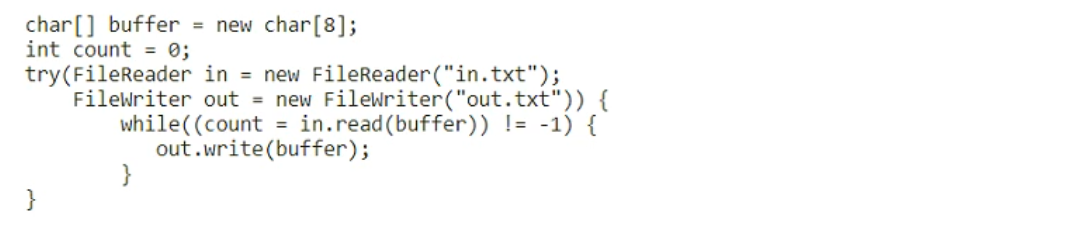
Community Insight
The core concept tested is how java.io.FileReader handles partial reads and what FileWriter writes; the common trap is assuming the entire buffer content (including stale data) is written instead of just the count returned by read().
This question tests the behavior of FileReader when reading into a fixed-size char array buffer. It establishes that only the characters actually read are written to the output file, ignoring any leftover data from previous buffer fills.
Many learners choose option F (which is not listed in the provided A-E options but appears in comments) or assume all 8 chars are always written, failing to realize that `out.write(buffer, 0, count)` restricts output to the actual number of characters read.
Community Discussion (8 comments)
Comments & Corrections
No comments yet — spotted an error or have a note? Share it below.
Expert Analysis
Why the Answer Is Correct
The code uses achar[] buffer of size 8. The input file contains '0123456789' (10 characters). In the first iteration, in.read(buffer) reads the first 8 characters ('01234567') and returns 8. The code then executes out.write(buffer, 0, count), which writes exactly those 8 characters to out.txt. In the second iteration, in.read(buffer) reads the remaining 2 characters ('89') into the first two positions of the buffer and returns 2. The code then executes out.write(buffer, 0, 2), appending '89' to out.txt. The total content of out.txt becomes '0123456789'. Therefore, Option D is correct.Why the Other Options Are Wrong
Option A (012345678) implies only 9 characters were written, which is incorrect as all 10 are read. Option B (01234567801234) suggests double writing or incorrect buffering logic. Option C (01234567) implies only the first chunk was written and the rest ignored. Option E (012345678901234) suggests garbage data or repeated writing. None of these match the precise byte/char count logic ofread returning specific counts.Community Comment Notes
Several commenters incorrectly claim the answer is 'F' (often citing '0123456789234567'), likely confusing this with a different version of the question whereout.write(buffer) is used without the offset/count parameters, or misinterpreting the buffer reuse. One commenter correctly notes that running the program yields '0123456789', confirming that only the read characters are written. Another points out that if count is used correctly, the output length matches the input length. Official Reference
Exam Strategy
Always check the arguments passed to write(). If it is write(buffer, 0, count), only count characters are written. If it is just write(buffer), the entire buffer is written, potentially including stale data from previous iterations.
Frequently Asked Questions
Why doesn't the second read overwrite the first output?
It does append. The first write adds '01234567'. The second write adds '89'. The total is '0123456789'.
What happens if I use out.write(buffer) instead of out.write(buffer, 0, count)?
It would write the entire 8-char buffer every time, including old data, leading to corrupted output like '0123456789234567'.