Java Concurrent Thread Execution Order
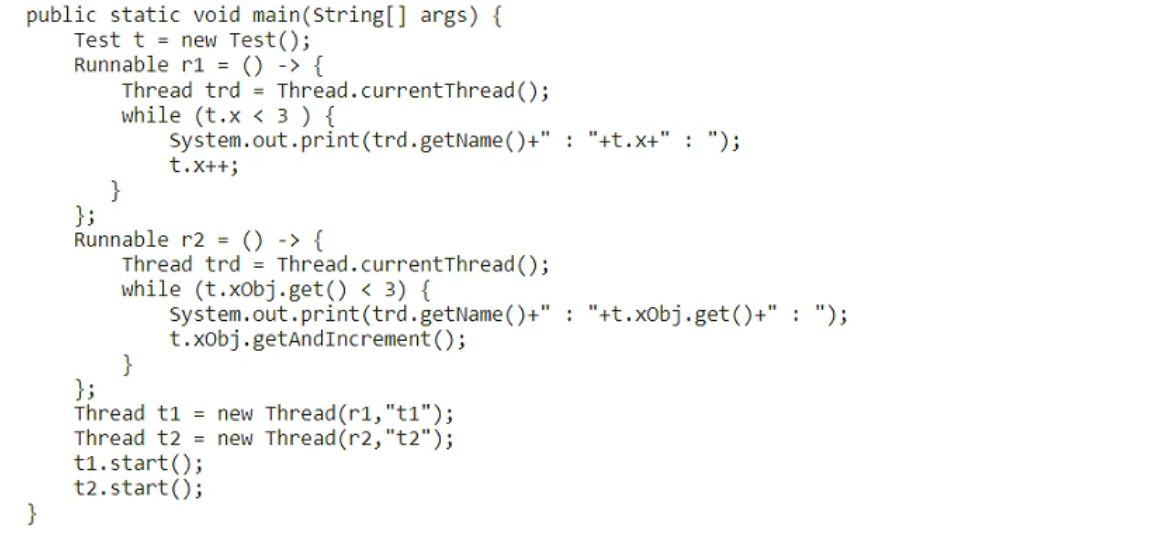
Given the code fragment: and Which is true? -  -
- 
Community Votes
100% of anonymous learners picked answer A. Votes are pick records left by other test-takers — they are not the verified answer.
Community Insight
The core concept tested is thread safety and scheduling; the common trap is assuming a fixed execution order due to code structure rather than recognizing the lack of synchronization guarantees.
This question tests the unpredictability of thread scheduling in Java concurrent programming. It establishes that without explicit synchronization, the interleaving of operations from multiple threads is non-deterministic.
Candidates often choose Option B, incorrectly assuming that thread t1 will always complete its loop before t2 starts or that they will strictly alternate, ignoring that the OS scheduler decides execution order.
Community Discussion (7 comments)
Comments & Corrections
No comments yet — spotted an error or have a note? Share it below.
Expert Analysis
Why the Answer Is Correct
The correct answer is A because the program involves two threads (t1 and t2) executing concurrently without any synchronization mechanisms likesynchronized, Lock, or join. In Java, the thread scheduler determines when each thread runs. Since there is no guarantee of ordering between the increment/print cycles of t1 and t2, the output can appear in various interleaved orders, such as t2:1:t2:2:t1:1:t1:2 or t1:1:t2:1:t1:2:t2:2. The term 'random order' here refers to this non-deterministic interleaving.Why the Other Options Are Wrong
Option B implies a strict, predictable sequence (e.g., all t1 outputs then all t2, or strict alternation), which is false because thread scheduling is preemptive and dependent on system load and priority. Option C suggests an infinite loop with identical output, which is incorrect because the variablesx and xObj are incremented and eventually reach values >= 3, terminating the loops. Option D is incorrect because there are no runtime errors; volatile and AtomicInteger ensure visibility and atomicity of individual reads/writes, preventing exceptions during these simple operations.Community Comment Notes
Community consensus strongly supports Option A. As user james2033 noted, the output shows varied sequences liket2: 1: t2: 2: t1: 1: t1: 2, confirming the unpredictable nature. ASPushkin highlighted that without monitor usage, there is no thread interference constraint forcing a specific order. Multiple users confirmed that this behavior was observed during testing, validating the non-deterministic result. Exam Strategy
When analyzing concurrent Java code questions, first look for synchronization keywords (synchronized, wait/notify, Lock). If none are present, assume the execution order is non-deterministic unless the problem explicitly states otherwise (e.g., using join()). Always distinguish between thread visibility (handled by volatile/atomic classes) and thread ordering (requires synchronization).
Frequently Asked Questions
Does volatile ensure thread execution order?
No. Volatile ensures visibility of changes across threads but does not impose any ordering or mutual exclusion on execution flow.
Why doesn't AtomicInteger cause blocking?
AtomicInteger uses CAS (Compare-And-Swap) instructions at the hardware level, allowing non-blocking increments without acquiring locks.