Java Instant truncatedTo ChronoUnit MINUTES Result
Given the code fragment: What is the result? - 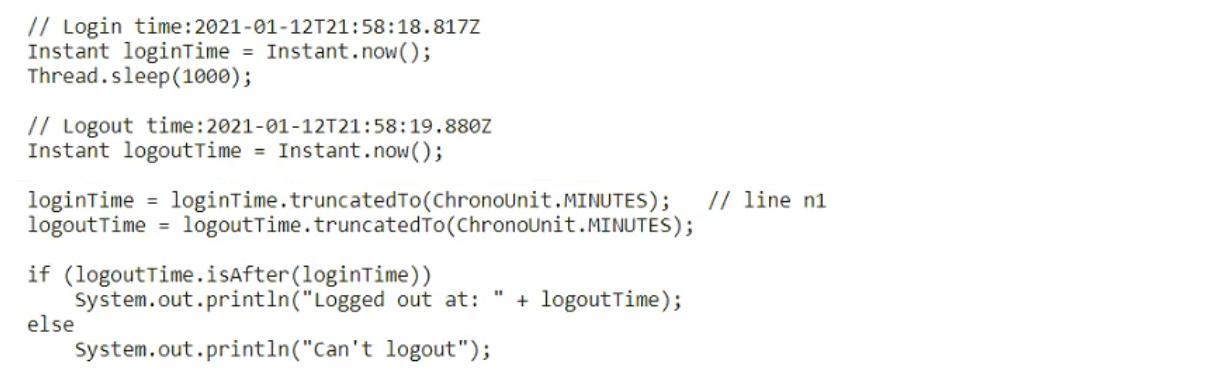
Community Votes
100% of anonymous learners picked answer A. Votes are pick records left by other test-takers — they are not the verified answer.
Community Insight
The key trap is confusing 'truncation' with 'rounding'; truncation always rounds down, making the login time earlier than logout time.
This question tests the behavior of Instant.truncatedTo() in Java 8+ datetime API. The correct result is determined by how truncating to minutes affects comparison logic.
Learners often choose D, assuming truncation rounds to the nearest minute or that seconds/nanoseconds are preserved, leading them to believe the times remain distinct enough for a successful logout message.
Community Discussion (6 comments)
Comments & Corrections
No comments yet — spotted an error or have a note? Share it below.
Expert Analysis
Why the Answer Is Correct
The code usesloginTime.truncatedTo(ChronoUnit.MINUTES). This method sets all fields smaller than minutes (seconds and nanoseconds) to zero. Since both loginTime and logoutTime occur within the same minute (21:58), truncating loginTime results in 2021-01-12T21:58:00Z. The logoutTime remains 2021-01-12T21:58:19.880Z. The condition if (!loginTime.isBefore(logoutTime)) checks if login is NOT before logout. Since 21:58:00 IS before 21:58:19, the condition is false, and the else block executes, printing "Can't logout".Why the Other Options Are Wrong
Option B and D represent the actual timestamp values but ignore the program flow logic; they would only print if the condition were true. Option C suggests a compilation error, buttruncatedTo is a valid method on Instant accepting ChronoUnit. The syntax is correct.Community Comment Notes
Most users correctly identified A as the answer. As minhdev noted, "truncatedTo coverts the logoutTime=LoginTime => else is reached," highlighting the logical outcome. James2033 provided a full trace showing the timestamps confirm the 'isBefore' relationship holds true.Official Reference
Exam Strategy
Always trace the value changes step-by-step. When truncatedTo is used, remember it chops off lower units, potentially making two distinct times equal or altering their order relative to expectations.
Frequently Asked Questions
Does truncatedTo round or truncate?
It truncates (chops off) lower units. It does not round to the nearest unit.
Why doesn't it print the logged out message?
Because the login time is strictly before the logout time, the !isBefore check fails, triggering the else block.