Invoking All Callable Objects in a Set
Given the code fragment: Which code fragment invokes all callable objects in the workers set? - 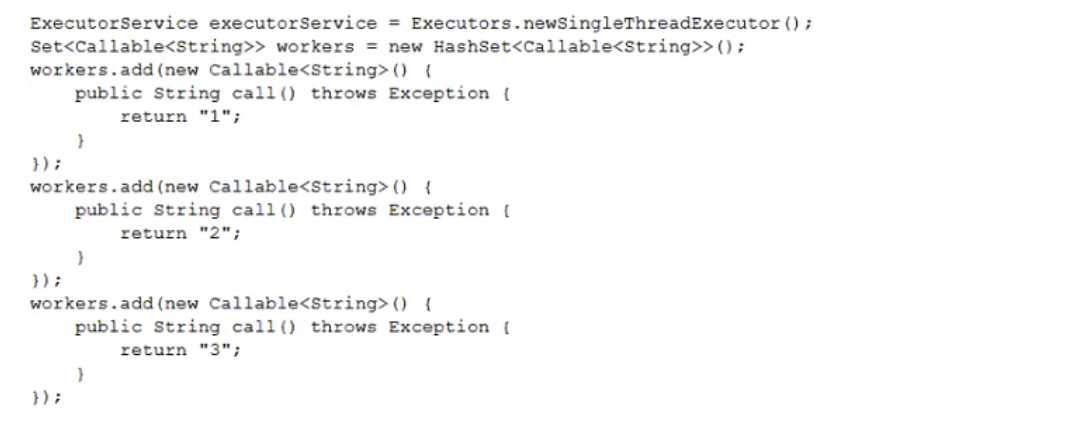
Community Votes
100% of anonymous learners picked answer D. Votes are pick records left by other test-takers — they are not the verified answer.
Community Insight
The question tests the difference between ExecutorService invocation methods, specifically that invokeAll() executes all callables and blocks until completion, whereas invokeAny() only returns the first successful result.
This page determines the correct way to invoke all Callable objects in a set using an ExecutorService in Java. It establishes that invokeAll() is the appropriate method to execute all tasks concurrently and retrieve their Future results.
Choosing invokeAny() (Option C) because it sounds like it invokes all, but it actually returns the result of just one successfully completed task.
Community Discussion (3 comments)
Comments & Corrections
No comments yet — spotted an error or have a note? Share it below.
Expert Analysis
Why the Answer Is Correct
Option D usesexecutorService.invokeAll(workers), which is the standard method to execute a collection of Callable tasks concurrently. As SrinivasJasti noted, "This method takes a collection of Callable tasks and executes them concurrently. It blocks until all tasks are complete." It correctly returns a List<Future<String>> allowing the retrieval of each task's result.Why the Other Options Are Wrong
Options A and B incorrectly reference a variablecThreads which is not declared in the scope of the question; the set is named workers. Option C uses invokeAny, which does not invoke all tasks to completion in a way that returns all results. Instead, it returns the result of the first successfully completed task and cancels the rest, making it unsuitable for processing all workers.Community Comment Notes
The community correctly identified thatinvokeAll is required to process all tasks and return a list of Futures, as james2033 demonstrated with the full code snippet. Additionally, supersquax pointed out the distractors: "A and B reference 'cThreads' which isn't declared anywhere" and that "C uses invokeAny, which doesnt return a List." Official Reference
Exam Strategy
Know the distinct behaviors of ExecutorService bulk execution methods: invokeAll() blocks and returns Futures for all tasks, while invokeAny() blocks only until the first task succeeds. Pay close attention to variable names in the code fragments to eliminate options with undeclared references.