How Many PreparedStatements and SQL Statements Execute in This JDBC Code?
Given the data of the EMP table: Assuming that jdbcURL, username, and password are declared and initialised. Which two happen upon execution? (Choose two.) - 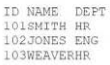 -
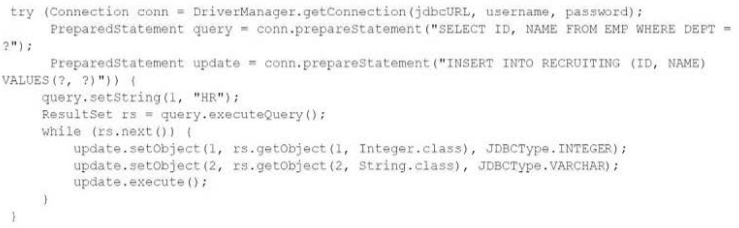
- 
Community Votes
67% of anonymous learners picked answer AB. Votes are pick records left by other test-takers — they are not the verified answer.
Community Insight
You must separate PreparedStatement object creation from statement execution — the trap is assuming every execute call inside the loop needs a brand-new PreparedStatement (option E) or counting only distinct SQL strings (option C).
This 1Z0-819 JDBC question asks what actually happens when the EMP code runs — how many PreparedStatement objects are created and how many SQL statements are executed. The verdict is A and B: only two PreparedStatement objects are built, but three SQL statements hit the database.
Picking BC — learners count the two distinct SQL strings and call it two executed statements, forgetting that the re-parameterised PreparedStatement is executed a second time, which makes three actual executions.
Community Discussion (4 comments)
Comments & Corrections
No comments yet — spotted an error or have a note? Share it below.
Expert Analysis
Why the Answer Is Correct
The code opens one Connection and prepares exactly two PreparedStatement objects: one bound to the SELECT that reads the EMP data and one bound to the data-modification statement run afterwards. That modification PreparedStatement is re-parameterised with setInt/setString and executed again for a second parameter set driven by the EMP rows, so the Connection sends one query plus two updates — three SQL statements in total. Because the same PreparedStatement object is reused instead of being rebuilt each pass, the object count stays at two, which is precisely what options A and B state. This is why the pair A+B describes the execution accurately while the alternatives mis-count one of the two dimensions.Why the Other Options Are Wrong
Option C claims only two SQL statements are executed, which ignores the repeated execution of the already-prepared modification statement — the driver really does send three statements. Option D invents a memory leak: Connection, PreparedStatement and ResultSet are JDBC resources, and when the Connection is closed (as the shown code does) its statements and result sets are released, so nothing leaks. Option E confuses object creation with execution — calling executeQuery/executeUpdate repeatedly on the same PreparedStatement never creates a new PreparedStatement object, so 'three objects' cannot happen here. That leaves A and B as the only consistent pair.Community Comment Notes
As cathDev explained, the code "It creates two PreparedStatement objects" — one for the SELECT and one for the DML statement — which immediately rules out option E. ASPushkin frames the same arithmetic from the execution side, describing one SELECT and "two for update in the loop", i.e. three executed statements, while also warning that the count collapses if the target table does not exist and the insert fails. The 67-to-33 vote split between AB and BC reflects exactly this tension: counting every execution (A) versus counting only distinct SQL strings (C).Official Reference
Exam Strategy
For JDBC 'what happens upon execution' questions, count two things on separate lines of scratch paper: the number of distinct PreparedStatement/Statement objects created (a constructor/prepareStatement call) and the number of executeQuery/executeUpdate/executeBatch calls. The distractors almost always swap these two counts, so verify that your chosen pair matches the 'Choose two' instruction.
Frequently Asked Questions
Why is option E (three PreparedStatement objects) wrong for this JDBC code?
The PreparedStatement is prepared once and then reused with new setInt/setString parameters before each executeUpdate, so only two objects exist even though it is executed more than once.
Why is option D (memory leaks) not the answer?
No resource is abandoned: JDBC releases a Connection's Statements and ResultSets when the Connection is closed, which the shown code does, so no leak occurs.