What Output Does This Java Program Print for Manager AA?
Given: What is the result? - 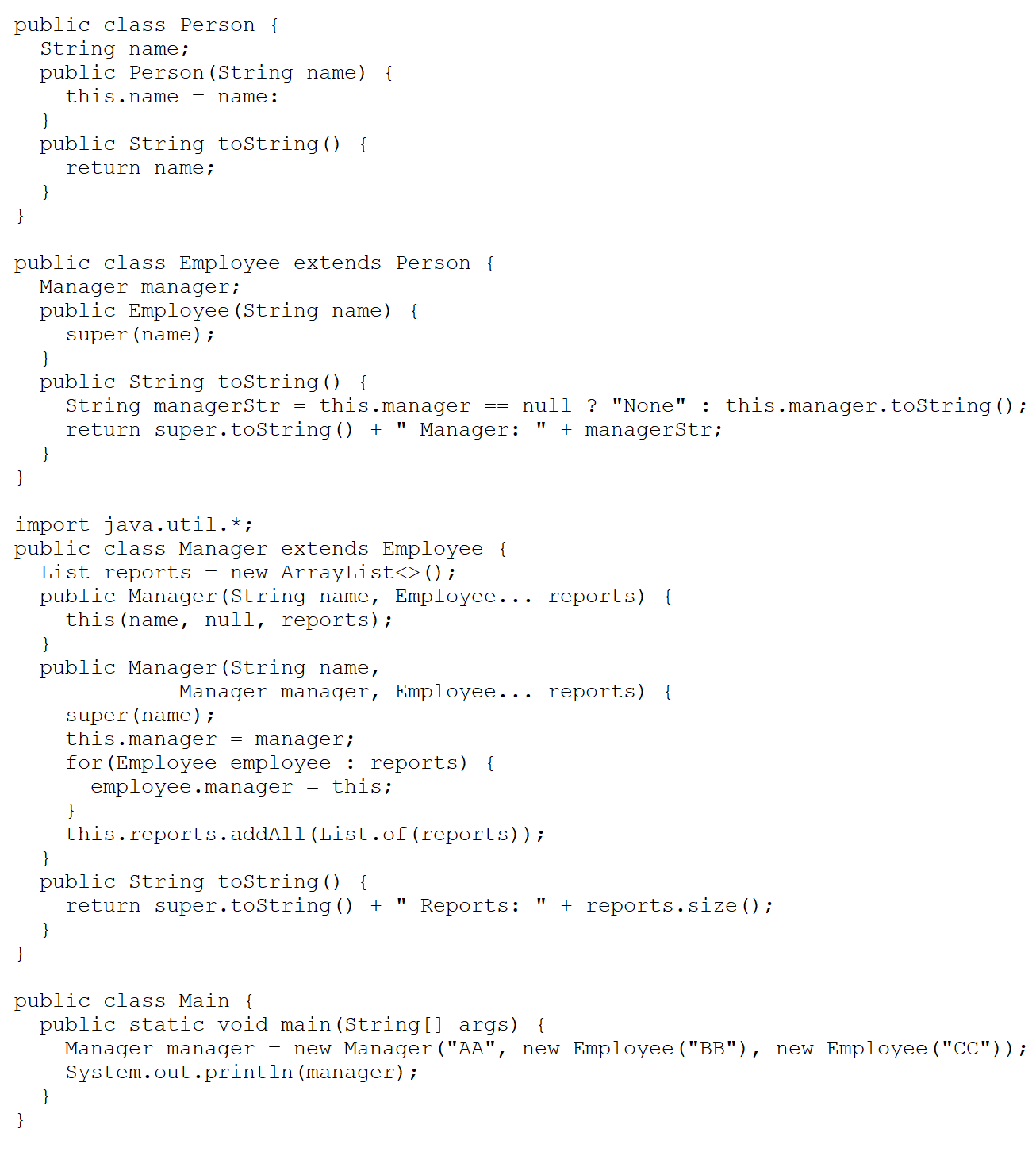
Community Votes
75% of anonymous learners picked answer B. Votes are pick records left by other test-takers — they are not the verified answer.
Community Insight
Tests how an overridden toString() in a Manager/Employee hierarchy formats a null manager reference and a reports collection size; the trap is assuming the printed line stops after "None" or that null triggers a NullPointerException.
A Java program builds a Manager named AA that has no manager of its own but holds two Employee reports, and relies on an overridden toString() to render the object. The page confirms the printed line is "AA Manager: None Reports: 2", so option B is correct.
Picking D, "AA Manager: None", because learners read only the manager portion of toString() and forget that the same method unconditionally appends the Reports count of the two subordinates.
Community Discussion (6 comments)
Comments & Corrections
No comments yet — spotted an error or have a note? Share it below.
Expert Analysis
Why the Answer Is Correct
The program creates a Manager named AA whose own manager reference is null and whose reports collection contains two employees (BB and CC). The class overrides toString to concatenate three things: the name, a null-safe rendering of the manager field (the literal "None"), and the size of the reports list. Because System.out.println(Object) delegates to String.valueOf and therefore calls toString, the entire composite string reaches the console as a single line. That yields exactly "AA Manager: None Reports: 2", matching option B character for character, including the space before the Reports count.Why the Other Options Are Wrong
Option A ("nothing") would mean the object is never printed or that toString returns an empty string, but the snippet explicitly prints the AA object. Option C ("AA") would only appear if a getName accessor were printed on its own, discarding the manager and reports segments. Option D is the classic trap: "AA Manager: None" is merely the first half of the string the same method builds, and because the list holds BB and CC, the trailing "Reports: 2" is unavoidable. Option E is wrong because a null manager is guarded by a ternary/null check rather than dereferenced, and the reports collection is initialized (field initializer or constructor) before any size call, so no NullPointerException occurs.Community Comment Notes
Learners who actually executed the snippet land on the same result — one writes simply "tested." and another posts "B. TESTED.", both confirming option B. A commenter who voted D nevertheless pasted the text "AA Manager:no managerReports:2 IS CORRECT", which is the option B output, showing that the Reports count was the detail that confused them. As cathDev explains, manager "AA" has two reports (BB and CC), so the printed line must carry "Reports: 2" rather than the "None" abbreviation alone.Exam Strategy Check
When a println prints an object, mentally expand the overridden toString field by field instead of stopping at the first property, since the trailing collection size is the usual discriminator between B and D here.Official Reference
Exam Strategy
For any println(object) question, reconstruct the full toString() concatenation in order and check whether null fields are guarded before assuming an exception. On 1Z0-819 the two top candidates usually differ by one appended token, so verify each segment against the actual field values (here, two reports).
Frequently Asked Questions
Why does the manager field print as None instead of throwing a NullPointerException?
The toString() guards the manager reference (typically a ternary), so a null manager is rendered as the literal text "None" instead of being dereferenced.
Why isn't option D "AA Manager: None" the printed output?
The same toString() also appends the reports collection's size, and AA was created with two reports (BB and CC), so "Reports: 2" must appear in the line.