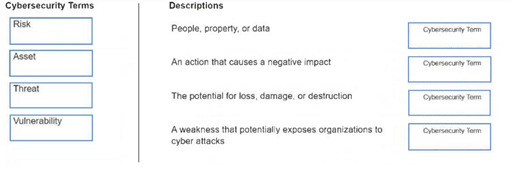
Cybersecurity Risk Management Terms Drag Drop
DRAG DROP
Move each cybersecurity term from the list on the left to the correct description on the right.
Note: You will receive partial credit for each correct answer.
Community Insight
The key insight is distinguishing between the source of harm (Threat), the thing being harmed (Asset), the weakness exploited (Vulnerability), and the potential outcome (Risk). A common trap is confusing Threat with Vulnerability or Risk with Loss.
This question tests the fundamental definitions of Asset, Threat, Risk, and Vulnerability in cybersecurity risk management. The correct mapping aligns each term with its standard industry definition to demonstrate understanding of core security concepts.
Learners often swap 'Threat' and 'Vulnerability', thinking a threat is a weakness rather than an action or agent, or they confuse 'Risk' with the actual damage rather than the potential for it.
Community Discussion (1 comments)
Comments & Corrections
No comments yet — spotted an error or have a note? Share it below.
Expert Analysis
Why the Answer Is Correct
The correct mappings are based on standard NIST and CompTIA definitions used in the Security+ exam. An Asset is anything of value that needs protection (people, property, data). A Threat is any circumstance or event with the potential to adversely impact operations through an information system (the action/agent). A Vulnerability is a weakness in an information system, system procedures, or controls that could be exploited (the flaw). Risk is the potential for loss, damage, or destruction of an asset as a result of a threat exploiting a vulnerability.Why Other Candidate Answers Are Wrong
Incorrect pairings usually stem from semantic confusion. For example, labeling a 'weakness' as a 'Threat' ignores that threats are active agents or events, while vulnerabilities are passive flaws. Labeling 'loss' as 'Vulnerability' confuses the consequence with the cause. These errors indicate a lack of clarity on the causal chain: Threat + Vulnerability -> Risk -> Impact.Community Comment Notes
As Roattana noted in the comments, the correct associations are clear when breaking down the definitions: people/data are Assets; negative impacting actions are Threats; potential for loss is Risk; and weaknesses exposing orgs are Vulnerabilities. This consensus aligns with official study materials.Exam Strategy
When facing drag-and-drop questions on terminology, read the definition carefully and identify the noun vs. verb distinction. Assets are nouns (things), Threats are often verbs or agents (actions), Vulnerabilities are adjectives describing states (weaknesses), and Risks are probabilistic outcomes (potential).
Frequently Asked Questions
What is the difference between a Threat and a Vulnerability?
A Threat is an action or agent that causes harm, while a Vulnerability is a weakness that allows the threat to succeed.
How do I define Risk in cybersecurity terms?
Risk is the potential for loss, damage, or destruction resulting from a threat exploiting a vulnerability against an asset.