Match Attacker Types to Scenarios: CompTIA Security+ SY0-601
DRAG DROP
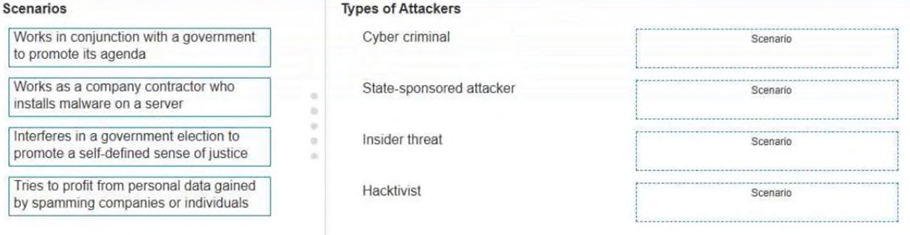
Move each scenario from the list on the left to the correct type of attacker on the right.
Note: You will receive partial credit for each correct answer
Community Insight
This question tests your ability to distinguish between attacker types by analyzing their primary motivation, with the common trap being confusion between state-sponsored actors and hacktivists due to overlapping political goals.
Learn how to correctly identify and categorize cyber attackers based on their motivations and actions in real-world scenarios for the CompTIA Security+ exam.
Learners often incorrectly classify hacktivists as state-sponsored attackers because both may target government entities; however, the key distinction is that hacktivists act independently for a cause, whereas state-sponsored actors are funded and directed by a nation-state.
Community Discussion (1 comments)
Comments & Corrections
No comments yet — spotted an error or have a note? Share it below.
Expert Analysis
Why the Answer Is Correct
The correct classification relies on identifying the primary driver of each attack scenario. Cyber criminals are driven by financial gain, typically through spam or data theft. State-sponsored attackers work directly under government direction to advance national interests or geopolitical agendas. Insider threats are individuals within the organization who misuse their access, such as a contractor installing malware. Hacktivists are motivated by ideology or a sense of justice, often interfering in political processes like elections.Why Other Candidate Answers Are Wrong
Misclassifying these attackers usually stems from focusing on the target rather than the motive. For instance, targeting a government election might seem like a state-sponsored act, but if the actor is an independent group promoting a specific ideology without state backing, it is hacktivism. Similarly, financial motives define cyber crime, not just the method used (spamming).Community Comment Notes
As Roattana noted in the comments, the distinctions are clear when you align the actor's goal with their action: profit for cyber criminals, government agenda for state-sponsored, internal access abuse for insiders, and ideological justice for hacktivists.Exam Strategy
When faced with attacker type questions, always ask 'Why?' first. Determine the primary motivation (money, politics, ideology, revenge) before looking at the methods used. This mindset helps avoid traps where multiple attacker types might use similar techniques.
Frequently Asked Questions
What is the main difference between a state-sponsored attacker and a hacktivist?
State-sponsored attackers are funded and directed by a nation-state to further geopolitical interests, while hacktivists act independently to promote a social or political cause.
Can an insider threat be external to the company?
No, an insider threat specifically refers to someone with authorized access to the organization's systems, such as employees or contractors, who misuses that access.