What causes high latency based on Linux network interface counters?
Users are experiencing high latency when accessing a web application served by a Linux machine. A systems administrator checks the network interface counters and sees the following: Which of the following is the most probable cause of the observed latency? - 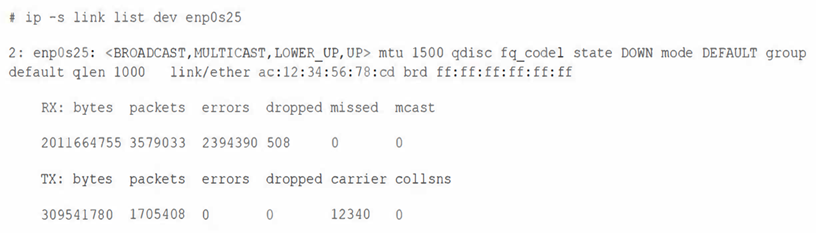
Community Votes
100% of anonymous learners picked answer B. Votes are pick records left by other test-takers — they are not the verified answer.
Community Insight
The exam tests your ability to correlate specific interface counter errors (RX errors, TX carrier failures) with physical or cabling issues, while avoiding the trap of assuming a disconnected or unconfigured interface when traffic is clearly flowing.
High latency on a Linux server can be diagnosed by analyzing network interface counters such as RX errors, TX carrier failures, and dropped packets. Community consensus confirms that physical or data-link layer connection problems are the most probable cause when these specific errors are present.
Option A is a common wrong answer because some users misread the interface state or assume that high latency means no connectivity, ignoring the evidence of active RX/TX traffic in the counters.
Community Discussion (4 comments)
Comments & Corrections
No comments yet — spotted an error or have a note? Share it below.
Expert Analysis
Why the Answer Is Correct
Option B is correct because the presence of a high number of RX errors (e.g., 2,394,390) and TX carrier failures (e.g., 12,340) directly indicate a physical or data-link layer connection problem, such as a faulty cable, bad NIC, or duplex mismatch. These errors cause packet retransmissions and result in high latency, even though some traffic is still passing. The interface is clearly UP and passing traffic, which rules out a complete disconnection.Why the Other Options Are Wrong
Option A is incorrect because the interface counters show active RX and TX traffic, meaning the interface is not disconnected. Option C is wrong because the interface is actively sending and receiving packets, which would not be possible without a valid IP configuration in this context. Option D is incorrect because gateway unreachability would manifest as routing errors or ICMP failures, not as RX errors and TX carrier failures at the interface level.Community Comment Notes
Community members strongly support Option B, with multiple comments highlighting that RX errors and TX carrier failures are classic signs of physical layer issues. Comment [2] effectively explains that carrier problems result in poor connections and difficulty communicating, while comment [3] correctly notes that the interface is marked UP and has traffic, ruling out disconnection. Comment [4] is an outlier that incorrectly selects A, likely due to misinterpreting the interface state or overlooking the traffic evidence.Official Reference
Exam Strategy
When analyzing Linux network interface counters for latency issues, always correlate specific error types with their OSI layer: RX/TX errors and carrier failures point to physical/cabling problems, while zero traffic or DOWN state indicates configuration or disconnection issues. Eliminate options that contradict the evidence of active traffic in the counters.