What does a DNS AXFR zone transfer in logs indicate?
A security analyst is reviewing the logs on an organization's DNS server and notices the following unusual snippet: Which of the following attack techniques was most likely used? - 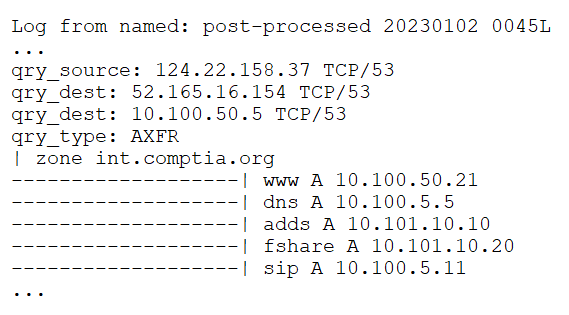
Community Votes
100% of anonymous learners picked answer C. Votes are pick records left by other test-takers — they are not the verified answer.
Community Insight
The exam tests your ability to correlate DNS log anomalies with reconnaissance techniques: an AXFR zone transfer is classic footprinting, not exfiltration or initial access.
Learn how DNS zone transfer (AXFR) requests are used for network footprinting. The Security+ community consensus is option C, as AXFR reveals internal IP addresses and hostnames that map the internal network.
Choosing E 'Exfiltrating data' because the snippet includes a domain name, but AXFR is a zone transfer that copies DNS records, not a data exfiltration technique.
Community Discussion (3 comments)
Comments & Corrections
No comments yet — spotted an error or have a note? Share it below.
Expert Analysis
Why the Answer Is Correct
A DNS zone transfer (AXFR) is used by a DNS server to replicate its zone database to another server. When an attacker sends an AXFR request to a poorly configured DNS server, they receive a complete list of resource records, including internal hostnames and IP addresses. This information provides a detailed map of the internal network, which is exactly what footprinting aims to achieve. The community comment by user [1] correctly states that AXFR can reveal internal IP addresses and hostnames, enabling further attacks. Similarly, comment [2] notes that AXFR is used for footprinting during the reconnaissance phase.
Why the Other Options Are Wrong
Option A (ISP-assigned address space) refers to identifying external IP ranges, not internal DNS records, and could be gathered via WHOIS or BGP tools, not AXFR. Option B (bypassing DNS sinkholing) is a defensive control that blocks malicious domains; AXFR does not circumvent sinkholes. Option D (initial access to the DNS server) would involve exploitation or credential abuse, whereas AXFR is an information-gathering technique, not a direct compromise. Option E (exfiltrating data) is incorrect because AXFR copies DNS zone data, not file contents, and the domain shown in the log is simply the zone being transferred.
Community Comment Notes
The community overwhelmingly voted for C, with all visible comments supporting that answer. Comment [1] provides the most detailed rationale, explaining that an AXFR request gives attackers a full DNS record list, which maps internal networking. Comment [2] reinforces that AXFR is a footprinting technique used in reconnaissance. Comment [3] also describes AXFR as a way to gather information about an internal network, confirming the consensus. These comments align with the Security+ objective that focuses on identifying reconnaissance and information-gathering techniques from network evidence.
Official Reference
Exam Strategy
When you see AXFR or zone transfer in logs, think of reconnaissance and footprinting. Eliminate options that involve exploitation or direct data theft—AXFR is purely an information-gathering technique that reveals internal network structure.
Related Analysis
Practice All SY0-701 Questions
Access 100 questions with complete answers and detailed explanations.
View Full SY0-701 Practice Test →