Investigating a Date-Triggered Database Deletion Script
A company's online shopping website became unusable shortly after midnight on January 30, 2023. When a security analyst reviewed the database server, the analyst noticed the following code used for backing up data: Which of the following should the analyst do next? - 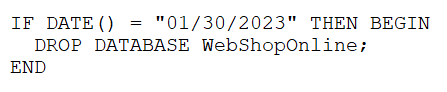
Community Votes
54% of anonymous learners picked answer A. Votes are pick records left by other test-takers — they are not the verified answer.
Community Insight
The question tests the ability to differentiate between external exploitation vectors and internal sabotage, recognizing that dormant, conditionally-executed code in scheduled jobs strongly indicates an insider with prior administrative access.
This scenario examines incident response when discovering a logic bomb embedded in automated backup routines. Community consensus emphasizes investigating insider threats, particularly terminated privileged users, as the most probable source of such targeted, scheduled sabotage.
Candidates frequently select reviewing WAF logs for command injection, misinterpreting the embedded SQL as an external attack rather than recognizing the deliberate, pre-planted nature of a logic bomb.
Community Discussion (11 comments)
Comments & Corrections
No comments yet — spotted an error or have a note? Share it below.
Expert Analysis
Identifying the Attack Vector
The provided SQL snippet demonstrates a logic bomb: a piece of code designed to execute a destructive action (dropping a database) only when a specific condition is met (a particular date). Unlike active exploits, logic bombs lie dormant until triggered, requiring careful planning and legitimate system access to embed.Why Option A is Correct
Option A correctly directs the analyst to investigate insider threats. Placing a date-specific deletion script into a routine backup job requires deep knowledge of the database architecture, backup schedules, and administrative privileges. As noted by multiple candidates in the community discussion, this pattern strongly suggests a disgruntled or terminated employee who had authorized access before leaving the organization. Checking recently terminated DBAs is the most direct and logical initial step to identify the perpetrator and assess their activity timeline.Why Other Options Are Incorrect
- Option B (WAF Logs): Web Application Firewalls monitor inbound HTTP traffic for vulnerabilities like SQL injection or command injection. However, the malicious code here is not being injected via a user-facing web form at runtime; it is hardcoded into a scheduled maintenance job. As several commenters pointed out, WAF logs would not reveal how the script was originally planted or executed internally.
- Option C (Malware Scan): While malware can cause data loss, the highly specific, conditional SQL syntax points to human-authored sabotage rather than random malicious software behavior. Forensic prioritization should focus on the most probable cause first.
- Option D (Ransomware Notes): Ransomware variants encrypt files and demand payment for decryption keys. This scenario describes outright database destruction, which aligns with sabotage or data wiping, not extortion.
Incident Response Best Practice
When uncovering malicious scripts in automated processes, always prioritize privilege and access reviews. Determining who created or modified the job, when it was deployed, and whether any high-risk personnel recently lost access will quickly narrow the investigation scope.Official Reference
Exam Strategy
When analyzing malicious code snippets in exam scenarios, examine the execution context and trigger mechanism. If the code is dormant, scheduled, or conditionally executed based on dates/system states, immediately suspect insider activity or pre-planted sabotage rather than real-time external exploitation. Match the technical artifact to the corresponding investigation path.
Related Analysis
Practice All SY0-701 Questions
Access 100 questions with complete answers and detailed explanations.
View Full SY0-701 Practice Test →