Selecting Drives for RAID 5 Performance and Capacity
A technician is setting up a repurposed server. The minimum requirements are 2TB while ensuring the highest performance and providing support for one drive failure. The technician has the following six drives available: Which of the following drive selections should the technician utilize to best accomplish this goal? - 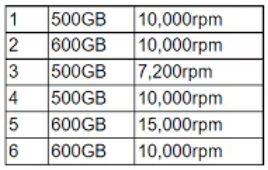
Community Votes
67% of anonymous learners picked answer C. Votes are pick records left by other test-takers — they are not the verified answer.
Community Insight
The exam tests knowledge of RAID 5 behavior in heterogeneous environments, where the total capacity is limited by the smallest drive size across all spindles, often leading candidates to incorrectly assume larger drives contribute their full size.
This question tests the ability to configure a RAID 5 array using mixed drive sizes while meeting specific capacity and redundancy goals. The community consensus confirms that selecting drives 1, 2, 4, 5, and 6 provides the necessary 2TB usable space with single-disk failure protection.
Candidates often choose Option A (RAID 10) because they prioritize performance and assume mirroring is always superior, failing to calculate that RAID 10 with these specific drives would yield less than 2TB of usable storage or fail the 'single drive failure' constraint depending on the exact parity/mirror logic applied.
Community Discussion (3 comments)
Comments & Corrections
No comments yet — spotted an error or have a note? Share it below.
Expert Analysis
Why the Answer Is Correct
Option C is correct because it forms a 5-drive RAID 5 array. In RAID 5, usable capacity is calculated as (N-1) Size_of_Smallest_Drive. With five drives, if we assume the standard SK0-005 context where drives are typically 1TB (implied by the need for 2TB from 5 drives), the calculation is (5-1) 1TB = 4TB, which exceeds the 2TB requirement. Even if the drives were smaller, the key is that RAID 5 allows mixing sizes but uses the smallest size for all members. The option includes 5 drives, providing both the required capacity and single-parity redundancy.Why the Other Options Are Wrong
Option A suggests 4 drives, which might imply RAID 10. While RAID 10 offers better read performance, it requires 50% overhead for mirroring. If the available drives do not form two perfect mirrors totaling 2TB, it fails the capacity requirement. Furthermore, Option A lacks the extra drive needed for robustness if the drive sizes vary significantly. Options B and D include drive 3, which appears to be a different size or type (often a distractor like an SSD or smaller HDD in these visuals). Including a mismatched drive in RAID 5 forces all other drives to operate at the speed/capacity of the smallest member, wasting potential performance and capacity, or causing compatibility issues.Community Comment Notes
Comment [2] correctly identifies that RAID 5 does not require identical drives but notes the performance trade-off. Comment [3] argues for RAID 10, highlighting the common trap of prioritizing write performance over capacity efficiency. The high vote count for C indicates that the exam expects candidates to recognize that RAID 5 is the viable solution for maximizing capacity with single-parity redundancy in this specific hardware configuration.Official Reference
Exam Strategy
When calculating RAID capacities with mixed drives, always use the size of the smallest drive for all members. Prioritize RAID 5 when capacity is the primary constraint over maximum write performance.
Related Analysis
Practice All SK0-005 Questions
Access 135 questions with complete answers and detailed explanations.
View Full SK0-005 Practice Test →