Conditional Access Template Exclusions for Policy Creator
You have a Microsoft Entra tenant that contains the users shown in the following table. Admin4 creates a Conditional Access policy named Policy1 by using the Require multifactor authentication for Azure management template. Which users will be required to use multi-factor authentication (MFA) the next time they sign in? - 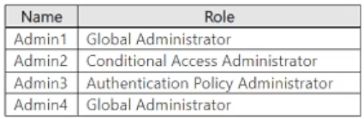
Community Votes
72% of anonymous learners picked answer C. Votes are pick records left by other test-takers — they are not the verified answer.
Community Insight
The core concept tested is the automatic exclusion of the policy creator when using predefined CA templates, a common trap where candidates assume all matching roles are affected.
This question tests the behavior of Microsoft Entra ID Conditional Access policies created from predefined templates. It establishes that the user creating the policy is automatically excluded to prevent lockout.
Candidates often select D (All admins) because they miss the implicit exclusion rule or assume MFA is enforced on everyone with admin privileges regardless of creation context.
Community Discussion (7 comments)
Comments & Corrections
No comments yet — spotted an error or have a note? Share it below.
Expert Analysis
Why the Answer Is Correct
When a Conditional Access policy is created from a predefined template (such as 'Require multifactor authentication for Azure management'), Microsoft Entra ID automatically adds an exclusion for the user who created the policy. This safety mechanism prevents the administrator from being locked out of their own account if the new policy introduces a blocking condition. In this scenario, Admin4 created Policy1; therefore, Admin4 is excluded from the enforcement of Policy1. The policy applies to the other users in the specified roles (Admin1, Admin2, Admin3), requiring them to use MFA.Why the Other Options Are Wrong
Option A is incorrect because it excludes Admin1, who is a Global Administrator and not the creator, so they must comply. Option B is incorrect because it includes Admin4 (the creator, who is excluded) and excludes Admin2 and Admin3, who are also subject to the policy. Option D is incorrect because it fails to account for the automatic exclusion of the policy creator (Admin4).Community Comment Notes
The community consensus heavily favors C, with comments explaining the exclusion logic. As one commenter noted, "when you create CA policies from template the current user who is creating them is always excluded." Another user clarified that "Admin4 (Global Administrator, but POLICY CREATOR) → ❌ Not affected." Some users argued for D, stating the question lacks explicit context, but the standard behavior for template-based policies supports the exclusion.Exam Strategy
Always check if a Conditional Access policy is based on a template. If it is, remember that the creator is implicitly excluded. Do not assume that all users matching the role criteria are included without verifying exclusion conditions.
Frequently Asked Questions
Why is Admin4 excluded from MFA in this scenario?
Admin4 is excluded because they created the policy from a predefined template. Microsoft automatically excludes the creator to prevent accidental lockout.
Does this exclusion apply to manually created policies?
No. The automatic exclusion only applies when a policy is created from a predefined Microsoft template. Manually configured policies do not have this default exclusion.
Related Analysis
Practice All SC-300 Questions
Access 80 questions with complete answers and detailed explanations.
View Full SC-300 Practice Test →