Azure RBAC Scope and Built-in Role Permissions Analysis
Short answer
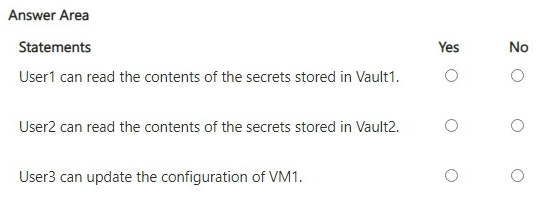
No, Yes, Yes. User1 cannot read secrets in Vault1 because their Key Vault Secrets User role is scoped to RG2, while Vault1 is in RG1. User2 can read secrets in Vault2 as they inherit the role via Group2 on RG2. User3 can update VM1 because the Owner role on RG1 provides full management permissions.
Question
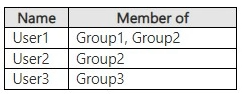
You have an Azure subscription named Sub1 that contains two resource groups named RG1 and RG2. Sub1 contains the users shown in the following table.
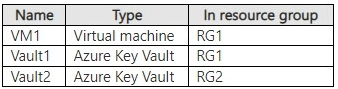
Sub1 contains the resources shown in the following table.
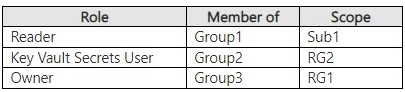
You create the role-based access control (RBAQ role assignments shown in the following table.
For each of the following statements, select Yes if the statement is true. Otherwise, select No.
NOTE: Each correct selection is worth one point.
Key Takeaways
The main trap is assuming role permissions apply globally within a subscription; they are strictly bound to the scope (RG/Resource) where the assignment was created.
Determine if users can perform actions based on Azure RBAC scope and built-in roles like Key Vault Secrets User and Owner. The correct answers are No, Yes, and Yes.
Common mistake: Learners often mark Statement 1 as 'Yes' because User1 is in Group2, forgetting that Group2's assignment is limited to RG2, and Vault1 is in RG1.
Expert Analysis
This question tests the precise scope of Azure RBAC role assignments and the specific permissions granted by built-in roles. The core constraint is that Role Assignments are evaluated against the resource hierarchy (Subscription > Resource Group > Resource). Permissions do not automatically flow across resource groups unless explicitly assigned at a higher level or the resource inherits from a parent scope.
Statement 1: "User1 can read secret contents in Vault1." This is No. User1 is a member of Group2, which has the 'Key Vault Secrets User' role assigned to RG2. However, Vault1 resides in RG1. Since there is no assignment for Group2 on RG1 or Sub1, User1 lacks permission on Vault1. While User1 has the 'Reader' role on Sub1, this only grants metadata access, not secret content access.
Statement 2: "User2 can read secret contents in Vault2." This is Yes. User2 is a member of Group2. Group2 has the 'Key Vault Secrets User' role assigned to RG2. Vault2 is located in RG2. Therefore, User2 inherits the necessary permissions to read secret contents.
Statement 3: "User3 can update VM1." This is Yes. User3 is assigned the 'Owner' role on RG1. In Azure RBAC, the Owner role includes all permissions of the Contributor role plus the ability to delegate assignments. The Contributor role allows managing resources, including updating Virtual Machines. Thus, User3 has full control over VM1.
Official Reference
https://learn.microsoft.com/en-us/azure/role-based-access-control/built-in-roles
This link opens the official vendor documentation in a new tab.
Exam Strategy
Always map the user to their group memberships first, then trace the group's role assignment to its specific scope (Subscription or Resource Group). Finally, verify if the target resource falls within that scope. Never assume inheritance across sibling resource groups without explicit assignment.
Frequently Asked Questions
Does the Reader role allow reading secret contents?
Can an Owner manage resources in a resource group?
Discussion 7 contributions
Compiled from public community threads and reader submissions, lightly edited for clarity. Handles and vote tallies are shown as recorded, and comments reflect the views of individual contributors.
From public community threads 7
-
northgaterebel 👍 151. No. Must be Key Vault Secrets User. User1 is only a Reader. 2. Yes. User2 is a Key Vault Secrets User! :D 3. Yes. User3 is the Owner of RG1 and has god-like powers. >:-) https://learn.microsoft.com/en-us/azure/role-based-access-control/built-in-roles
-
Sunth65 👍 8But Scope is limited only to RG2 !!
-
ethhacker 👍 4NYY, key: look at scope
-
Obi_Wan_Jacoby 👍 2NYY (as others stated) Key Vault Administrator: Can perform all data plane operations on a key vault and its objects, including certificates, keys, and secrets. Key Vault Reader: Can read metadata of key vaults and their certificates, keys, and secrets, but cannot read sensitive values such as secret contents or key material1. Key Vault Secrets User: Can read secret contents from a key vault1. Key Vault Certificates Officer: Can perform actions on the certificates of a key vault, excluding reading the secret and key portions1. Key Vault Certificates User: Can read certificate contents from a key vault1. Key Vault Contributor: Can manage key vaults but does not allow access to keys, secrets, and certificates. Key Vault Crypto Officer: Can perform cryptographic operations using keys in a key vault2. Key Vault Crypto User: Can perform cryptographic operations using keys in a key vault but cannot manage keys2. Key Vault Purge Operator: Allows permanent deletion of soft-deleted vaults
-
Oskarma 👍 2I think 1 is Yes too. User1 is in Group1 & Group2. Group2 is assigned to the role Key Vault Secrets User.
Show 2 more comments
-
d1e85d9 👍 2NO Yes Yes
-
ash2026 👍 1No, Yes, Yes User1 can read secrets in Vault1 "No" because User1 has Reader at subscription scope and Key Vault Secrets User through Group2 at RG2 scope. Vault1 is in RG1, so neither assignment grants secret-content access to Vault1. User2 can read secrets in Vault2 "Yes" because Key Vault Secrets User applies at RG2, where Vault2 resides. User3 can update VM1 "Yes" Owner applies at RG1, where VM1 resides.
Reader comments & corrections
No reader corrections yet — spotted an error or have a note? Share it below.
Related Analysis
Practice All SC-300 Questions
Access 80 questions with complete answers and detailed explanations.
View Full SC-300 Practice Test →