Remediating Insecure Exception Handling in SAST Reports
Short answer
A Implementing a secure logging framework replaces the insecure printStackTrace() call to prevent sensitive internal stack trace information from leaking to users.
Question
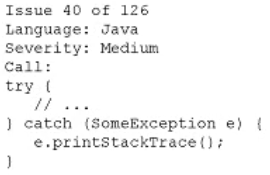
Which of the following is the best method to remediate this vulnerability?
Key Takeaways
The question tests knowledge of secure coding practices regarding exception handling, specifically recognizing that printing stack traces exposes sensitive internal data.
Learn how to remediate SAST-reported vulnerabilities involving insecure exception handling by implementing a secure logging framework instead of using printStackTrace().
Common mistake: Candidates may choose to remove the code lines entirely, believing deletion fixes the issue, but this breaks application logic and ignores the need for proper error management.
Expert Analysis
The code snippet exhibits a classic insecure exception handling pattern where printStackTrace is used to output diagnostic information. This method writes directly to the standard error stream, which can expose sensitive internal details such as class names, file paths, and stack traces to end-users or attackers. In a production environment, this leakage aids reconnaissance and potential exploitation.
Option A is the correct remediation because replacing printStackTrace with a secure logging framework (e.g., Log4j, SLF4J) allows for controlled log levels, proper sanitization of output, and directed storage that does not leak data to the client interface. As noted in community feedback, this approach provides control over how errors are handled and recorded without breaking application functionality.
Option B is incorrect because simply removing the exception handling code would likely cause unhandled exceptions to crash the application or alter its behavior unpredictably, failing to address the root cause of insecure information exposure. Option C suggests a long-term cultural fix but does not resolve the immediate vulnerability present in the current codebase. Option D is invalid because this is a genuine security flaw, not a false positive; printStackTrace is widely recognized as a poor practice in secure coding standards.
Exam Strategy
When analyzing SAST reports, always distinguish between syntax errors and security logic flaws. If an option involves deleting functional code blocks like try-catch statements, it is likely incorrect because it compromises availability. Look for options that introduce industry-standard security controls, such as specific libraries or frameworks, to replace insecure native methods.
Frequently Asked Questions
Why is printStackTrace() considered insecure?
What is the difference between fixing the code vs. training developers?
Community Votes
100% of anonymous learners picked answer A. Votes are pick records left by other test-takers — they are not the verified answer.
Discussion 4 contributions
Compiled from public community threads and reader submissions, lightly edited for clarity. Handles and vote tallies are shown as recorded, and comments reflect the views of individual contributors.
From public community threads 4
-
mosdef137 👍 6 Answered AUsing printStackTrace() is discouraged in production code because it can leak sensitive information and does not provide control over how or where the error is logged. The recommended practice is to replace printStackTrace() with a secure logging framework (such as java.util.logging, Log4j, or SLF4J), which allows you to control log levels, destinations, and to sanitize output, reducing the risk of information exposure B. Removing the five code lines reported with issues Simply removing the code would suppress error reporting entirely, making it harder to debug and maintain the application. It does not address the underlying need for exception handling and logging. C. Initiating a secure coding-awareness program with all the developers While valuable for long-term security culture, this is not a direct remediation for the specific code vulnerability flagged in the SAST report. D. Documenting the vulnerability as a false positive This is not a false positive. The use of printStackTrace() is a well-known security risk
-
leesuh 👍 3 Answered AA. Implementing a logging framework ✅ - Correct. Replace printStackTrace() with a secure logger (e.g., Log4j, SLF4J, java.util.logging) → controlled, non-sensitive error handling. B. Removing the five code lines reported with issues ❌ - Just deleting exception handling breaks functionality and doesn’t address proper error logging. C. Initiating a secure coding-awareness program ❌ - Good long-term strategy, but not a remediation for this code vulnerability. D. Documenting as a false positive ❌ - Wrong. This is a valid finding — exposing stack traces is a vulnerability.
-
xxxdolorxxx 👍 2 Answered AI vote A. A. Fixes the problem. Although a bit clunky but it is a viable solution for a pentester to suggest to a client. B. Would probably break code. Plus pentesters aren't devs, shouldn't be messing with the dev's work. C. Initially thought this, but it's more like a long term thing with hopes and wishes. Devs make mistakes all the time (I know because I am one, lol), doesn't necessarily fix the current problem. D. Although it could be a false positive it's not wise to just dismiss this because it could also be leak information. Our job is to better security the client.
-
b0b4dce 👍 1 Answered AprintStackTrace() is a built-in method in Java's java.lang.Throwable class that prints the diagnostic history of an exception directly to the standard error stream (System.err). When an error occurs, it displays the exact sequence of method calls (the "stack trace") that led to the failure, including the exception type, error description, class names, and specific line numbers where the code failed e.printStackTrace() is bad practice because it outputs sensitive debug details directly to the standard error stream (System.err), which can lead to information disclosure. The industry-standard remediation is to replace it with a robust, centralized logging framework (such as Log4j2, SLF4J, or Logback). This allows developers to securely log errors to server-side files, control the visibility of exceptions using log levels (e.g., DEBUG vs. ERROR), and automatically strip or mask sensitive data before it gets saved.
Reader comments & corrections
No reader corrections yet — spotted an error or have a note? Share it below.
Related Analysis
Practice All PT0-003 Questions
Access 120 questions with complete answers and detailed explanations.
View Full PT0-003 Practice Test →