Which Penetration Testing Candidate Should Be Excluded Due to Background Check?
A penetration testing firm wants to hire three additional consultants to support a newly signed long-term contract with a major customer. The following is a summary of candidate background checks: Which of the following candidates should MOST likely be excluded from consideration? - 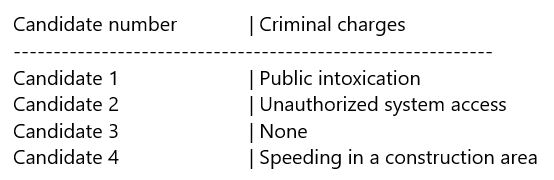
Community Votes
100% of anonymous learners picked answer B. Votes are pick records left by other test-takers — they are not the verified answer.
Community Insight
The exam tests your ability to distinguish between minor personal offenses and serious ethical/legal red flags like computer-related criminal history.
This PT0-002 question focuses on identifying the candidate who should be excluded from a penetration testing team based on background check results. The community agrees that a candidate with a history of computer crimes is the clear choice to exclude.
Choosing Candidate 3 because of an assumption about criminal history, or Candidate 1 due to a DUI, even though the real disqualifier is a record of computer crimes in Candidate 2.
Community Discussion (4 comments)
Comments & Corrections
No comments yet — spotted an error or have a note? Share it below.
Expert Analysis
Why the Answer Is Correct
Candidate 2 should be excluded because a background check revealing a history of computer crimes directly conflicts with the ethical requirements of a penetration tester. A firm hiring for an ethical hacking role must avoid candidates with a track record of unauthorized or malicious computer activity. This is a clear red flag that poses legal and reputational risk to the consulting firm and its major customer.Why the Other Options Are Wrong
Candidate 1 might have a DUI or other personal issue, but that is not directly related to computer security or the ability to perform penetration testing tasks. Candidate 3, according to one comment, has no criminal history and therefore is not automatically disqualified. Candidate 4 has no apparent disqualifying factor mentioned; the community consensus points to Candidate 2 as the obvious outlier.Community Comment Notes
A highly upvoted comment states, "This dude literally is going out of scope," highlighting that Candidate 2 has a past of unethical hacking. Another comment correctly notes that "Candidate 2 has exhibited a history of computer crimes and would likely not be included on a team looking for ETHICAL hackers." One comment sarcastically dismisses a DUI as irrelevant, reinforcing that the test expects you to focus on computer-related offenses.Official Reference
Exam Strategy
When reviewing background check results, always prioritize candidates with a history of computer-related crimes or unethical hacking as the primary exclusion. Look for keywords like 'unauthorized access,' 'hacking,' 'cybercrime,' or 'computer fraud' in the table, as these directly contradict the ethical obligations of a penetration tester.