How to Optimize Vertex AI Pipeline Caching for Cost Reduction?
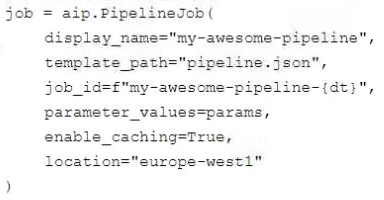
You developed a Vertex AI pipeline that trains a classification model on data stored in a large BigQuery table. The pipeline has four steps, where each step is created by a Python function that uses the KubeFlow v2 API. The components have the following names: You launch your Vertex AI pipeline as the following: You perform many model iterations by adjusting the code and parameters of the training step. You observe high costs associated with the development, particularly the data export and preprocessing steps. You need to reduce model development costs. What should you do? -  -
- 
Community Votes
52% of anonymous learners picked answer A. Votes are pick records left by other test-takers — they are not the verified answer.
Community Insight
Assesses knowledge of Kubeflow caching mechanics, where dynamic filenames invalidate cache keys and force expensive re-execution.
This scenario evaluates optimizing Vertex AI Pipelines by leveraging Kubeflow’s automatic caching to eliminate redundant compute expenses. Industry consensus confirms that static component naming is required to trigger successful cache hits.
Test-takers frequently select option B or C, incorrectly assuming v1 caching syntax applies to v2 APIs or that manual storage refactoring replaces native caching.
Community Discussion (14 comments)
Comments & Corrections
No comments yet — spotted an error or have a note? Share it below.
Expert Analysis
Why the Answer Is Correct
Kubeflow Pipelines automatically cache outputs based on component names and input hashes. When YAML filenames contain dynamic timestamps, the cache key changes on every run, forcing redundant execution of costly steps. Standardizing the filenames allows the cache to activate seamlessly, reusing previous results and significantly lowering development costs.Why the Other Options Are Wrong
Option B references kubeflow.v1.caching, which is incompatible with the KubeFlow v2 API explicitly mentioned in the scenario. Option C suggests restructuring the pipeline architecture unnecessarily, as caching can be enabled natively without moving steps. Option D introduces another timestamp, exacerbating the caching failure rather than resolving it.Community Comment Notes
Multiple voters highlighted that dynamic naming breaks caching logic, aligning with platform behavior (Comments 1, 4, 7). Users also correctly noted that v1 caching modules do not apply to v2 pipelines, effectively dismissing option B (Comments 3, 9). Several candidates initially favored manual cloud storage paths but recognized that native caching is the intended exam solution.Official Reference
Exam Strategy
Always identify dynamic variables in pipeline configurations, as they routinely disable deterministic caching and inflate resource usage. Favor built-in optimization features over manual architectural changes unless explicitly required.
Related Analysis
Practice All PMLE Questions
Access 65 questions with complete answers and detailed explanations.
View Full PMLE Practice Test →
-dt), suggesting that by removing this timestamp, the pipeline steps might not rerun as expected. Option C could be an approach, but it would require more effort to implement (since Kubeflow handles it automatically). Additionally, the beginning of the option only mentions moving the first step, which is the export, and doesn't say anything about preprocessing (which could be one of the more expensive steps). So, considering all of these factors, I think A is the best choice."