How to Deploy Chained scikit-learn Models with Version Control and Scale-to-Zero?
You have developed an application that uses a chain of multiple scikit-learn models to predict the optimal price for your company’s products. The workflow logic is shown in the diagram. Members of your team use the individual models in other solution workflows. You want to deploy this workflow while ensuring version control for each individual model and the overall workflow. Your application needs to be able to scale down to zero. You want to minimize the compute resource utilization and the manual effort required to manage this solution. What should you do? - 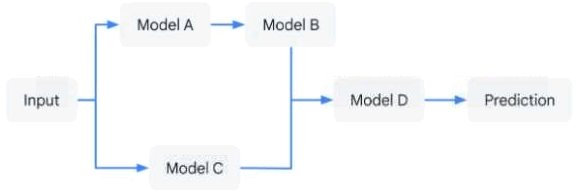
Community Votes
100% of anonymous learners picked answer C. Votes are pick records left by other test-takers — they are not the verified answer.
Community Insight
The exam tests mapping each requirement to the right managed service — Vertex AI Endpoints for model versioning and Cloud Run for scale-to-zero orchestration — with the trap being custom containers or BigQuery for jobs they are not designed for.
This PMLE exam question tests deploying a multi-model scikit-learn pricing workflow on Google Cloud while preserving per-model version control and scale-to-zero capability. The community unanimously (100% votes) recommends exposing each model via Vertex AI Endpoints and orchestrating the chain with Cloud Run.
Option A is the most tempting wrong answer because it correctly uses Vertex AI Endpoints but orchestrates with a custom container endpoint, which increases compute utilization and manual management overhead instead of leveraging serverless Cloud Run.
Community Discussion (4 comments)
Comments & Corrections
No comments yet — spotted an error or have a note? Share it below.
Expert Analysis
Why the Answer Is Correct
Option C satisfies every stated requirement using fully managed services. Exposing each individual model as a Vertex AI Endpoint provides built-in model versioning, traffic splitting, and monitoring, which is essential because team members reuse these models in other workflows. Cloud Run natively scales to zero when idle, directly addressing the scale-to-zero and minimal compute utilization requirements. As a serverless platform, Cloud Run also eliminates the operational burden of maintaining custom serving infrastructure. Commenters [1] and [3] explicitly map each requirement in the question stem to these two services.Why the Other Options Are Wrong
Option A uses Vertex AI Endpoints correctly but orchestrates the workflow with a custom container endpoint, which adds deployment complexity, keeps compute provisioned, and increases manual effort — the opposite of the stated goals. Options B and D rely on BigQuery to track model versions, but BigQuery is an analytics warehouse, not a model registry, so this creates fragile, manual bookkeeping. Comment [2] points out that loading raw model files into a custom container (B) causes versioning challenges and conflicts when models are shared across workflows. Option D additionally forfeits Vertex AI's managed versioning and monitoring by loading model files directly into Cloud Run.Community Comment Notes
The vote distribution is 100% for C, indicating strong and uncontested community consensus. Comment [1] systematically eliminates B and D because "BigQuery is not the best approach to track versions of model" and endorses Cloud Run for scale-to-zero with minimal manual effort. Comment [2] offers the clearest per-option breakdown, citing the management overhead of a custom orchestration container in A and the versioning conflicts in B. Comment [3] ties each requirement — version tracking, scale to zero, and minimal management — directly to a feature of option C, reinforcing why it is the only complete fit.Official Reference
Exam Strategy
Translate each phrase in the question stem into a managed service capability: 'version control for individual models' points to Vertex AI Endpoints or Model Registry, while 'scale down to zero' and 'minimize manual effort' point to Cloud Run. Eliminate options that repurpose a service outside its design intent, such as BigQuery for model versioning. When two options share the correct service for one requirement, pick the one whose second component adds the least operational overhead.
Related Analysis
Practice All PMLE Questions
Access 65 questions with complete answers and detailed explanations.
View Full PMLE Practice Test →