Why Does Redundant Switch Connectivity Fail Without a Root Bridge?
A network engineer configures a new switch and connects it to an existing switch for expansion and redundancy. Users immediately lose connectivity to the network. The network engineer notes the following spanning tree information from both switches. Which of the following best describes the issue? - 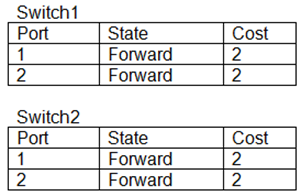
Community Votes
100% of anonymous learners picked answer C. Votes are pick records left by other test-takers — they are not the verified answer.
Community Insight
The question tests your understanding that STP uses a root bridge to decide which ports forward and which block; if no clear root is identified, loops form and connectivity collapses.
When a new switch is connected to an existing switch for redundancy, STP must elect a root bridge to block redundant paths. The CompTIA community identifies a missing/ambiguous root bridge as the primary cause of immediate connectivity loss.
Choosing link aggregation (B) confuses a potential solution with the root cause; while LAG can prevent STP from blocking redundant links, it does not fix the failure to have a defined root bridge.
Community Discussion (5 comments)
Comments & Corrections
No comments yet — spotted an error or have a note? Share it below.
Expert Analysis
Why the Answer Is Correct
In spanning tree protocol, every switch must agree on a single root bridge. The root bridge is the reference point used to determine port roles: root ports, designated ports, and blocked (alternate/backup) ports.
The scenario describes redundant links between two switches; without a clear root bridge, STP cannot block the redundant port, so a Layer 2 loop forms and broadcast frames circulate endlessly, causing users to lose connectivity.
The most-voted community answer supports C: "A root bridge is necessary to manage redundant paths." One user notes that when both switches show a cost of 2 on each port, they are "competing" for the root, creating instability. Thus identifying/configuring a root bridge is the correct fix.
Why the Other Options Are Wrong
A (port cost should not be equal): Equal port costs are normal and STP has deterministic tie-breakers (lowest bridge ID, then port priority), so equal costs alone do not cause failure.
B (ports should use link aggregation): Link aggregation is a useful redundancy feature, but it is a separate configuration technique; the immediate issue is STP's lack of a root bridge, not the absence of EtherChannel/LACP.
D (switch should be configured for RSTP): RSTP improves convergence speed but still relies on root bridge election. If no root bridge is identified, RSTP would also fail to break the loop.
Community Comment Notes
Comments with 7 and 3 likes both choose C, explaining that a root bridge is needed to manage redundant paths and prevent competing paths/instability.
A minority comment suggests B (link aggregation), and another suggests D (RSTP). While these are related to STP and redundancy, they do not describe the underlying cause captured in the spanning-tree output.
The official answer, as accepted by the largest vote group (92 votes for C), is consistent with standard STP troubleshooting.
Official Reference
Exam Strategy
On exam day, when you see a redundancy question with two switches and STP output, immediately ask 'Is a root bridge clearly elected?' If not, the answer is almost always about root bridge identification. Remember that STP blocks redundant ports based on the root bridge, so a missing or contested root causes loops and loss of connectivity.
Related Analysis
Practice All N10-009 Questions
Access 100 questions with complete answers and detailed explanations.
View Full N10-009 Practice Test →