BPDU Guard on access-sw01: What State Results After Receiving BPDUs?
Short answer
B Because access-sw01 has BPDU Guard enabled on Ethernet 0/5, receiving a BPDU from the distribution switch err-disables that interface.
Question
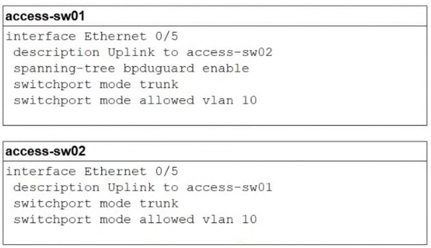
Which of the following is the state of the access-sw01 interface?
Key Takeaways
This question tests whether you can recognize BPDU Guard's err-disable action when a switch-to-switch link feeds BPDUs into an access port, rather than confusing it with admin-down, suspended, or line-protocol-down states.
BPDU Guard is a Spanning Tree protection feature that err-disables a switch port when it receives a BPDU. Here, access-sw01's Ethernet 0/5 is error disabled, making B the answer.
Common mistake: Choosing D (Line protocol down) because the link is physically connected; BPDU Guard does not merely bring the line protocol down—it places the port in an error-disabled state after receiving a BPDU.
Expert Analysis
The trigger on access-sw01
The exhibit shows spanning-tree bpduguard enable under access-sw01's Ethernet 0/5 interface. BPDU Guard is a Spanning Tree protection feature intended for ports that should connect only to end stations. It does not negotiate with a neighboring switch; it watches for Bridge Protocol Data Units and treats any received BPDU as a violation. The discussion reasoning makes the same point: because access-sw01 is cabled to another switch, the other switch sends BPDUs, and access-sw01 reacts immediately rather than forwarding normally.
What state results
When BPDU Guard receives a BPDU on a protected port, Cisco's documented behavior is to put that port into the error-disabled (err-disabled) state. Traffic stops, and the port must be recovered manually or by err-disable recovery. That makes option B correct. The interface is not simply blocked by spanning tree and it is not left in a normal STP state.
Why the other states do not fit
Option A would require shutdown under the interface; the scenario's configuration includes BPDU Guard, not an administrative shutdown. Option C, suspended, is associated with other conditions such as an inactive VLAN or certain port-state dependencies, not with a BPDU Guard violation. Option D, line protocol down, describes a link where physical connectivity exists but Layer 2 is not operational; BPDU Guard's deliberate action is stronger and produces an err-disabled port. The distinction matters because show running-config reveals the guard setting, while the resulting operational state is reported by commands such as show interfaces status.
Exam takeaway
The governing principle is cause-and-effect: a BPDU received on a BPDU Guard-enabled access port causes err-disable. Map the scenario's switch-to-switch connection to that rule before considering the distractors.
Official Reference
https://www.cisco.com/c/en/us/td/docs/ios-xml/ios/stp/configuration/15-mt/stp-15-mt-book.html
This link opens the official vendor documentation in a new tab.
Exam Strategy
When an exhibit shows spanning-tree bpduguard enable on an access-facing port and the topology links that port to another switch, predict the err-disable state before reading the choices. Separate configuration-derived state from operational state: shutdown causes administratively down, missing link can cause line protocol down, and VLAN issues can suspend a port, but BPDU Guard triggers err-disabled. On exam questions, map each option to its exact trigger and eliminate those unsupported by the running configuration.
Frequently Asked Questions
What exactly does BPDU Guard do when it receives a BPDU?
Why is the answer not line protocol down?
How can an err-disabled port be recovered?
Community Votes
100% of anonymous learners picked answer B. Votes are pick records left by other test-takers — they are not the verified answer.
Discussion 1 contributions
Compiled from public community threads and reader submissions, lightly edited for clarity. Handles and vote tallies are shown as recorded, and comments reflect the views of individual contributors.
From public community threads 1
-
ERB14 👍 1 Answered BBPDU Guard (spanning-tree bpduguard enable): On access-sw01, the interface Ethernet 0/5 has BPDU Guard explicitly enabled. When access-sw01 is connected to another switch (access-sw02), access-sw02 sends Spanning Tree Protocol (STP) Bridge Protocol Data Units (BPDUs) across the link. As soon as access-sw01 receives a BPDU on an interface with BPDU Guard active, it immediately shuts down the interface to prevent potential loops. The operational state resulting from this action is Error Disabled (err-disabled).
Reader comments & corrections
No reader corrections yet — spotted an error or have a note? Share it below.
Related Analysis
Practice All N10-009 Questions
Access 100 questions with complete answers and detailed explanations.
View Full N10-009 Practice Test →