What Network Function Does the IPv6 Address ::1 Represent?
An application is not working. When the log files are reviewed, the application continuously tries to reach the following destination: Which of the following is most likely associated with this IP address? - 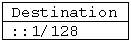
Community Votes
100% of anonymous learners picked answer D. Votes are pick records left by other test-takers — they are not the verified answer.
Community Insight
Tests recognition of the IPv6 loopback address ::1, with candidates commonly confusing it with link-local or APIPA ranges due to similar zero-based notation.
The IPv6 address ::1 is the standardized loopback address used for local host communication. Community consensus confirms this maps directly to IPv4's 127.0.0.1 and is a high-yield topic on the N10-008 exam.
Link local: Candidates often select this because IPv6 link-local addresses also begin with zeros in compressed form, but link-local strictly uses the fe80::/10 prefix for single-segment communication rather than host routing.
Community Discussion (4 comments)
Comments & Corrections
No comments yet — spotted an error or have a note? Share it below.
Expert Analysis
Why the Answer Is Correct
The address ::1 is the fully compressed representation of the IPv6 loopback address (0:0:0:0:0:0:0:1). It functions identically to the IPv4 127.0.0.1 address, allowing applications to communicate with the local network stack without sending packets out to external networks. This makes "Loopback" the only technically accurate classification.Why the Other Options Are Wrong
APIPA applies to IPv4 and uses the 169.254.0.0/16 range, while IPv6 utilizes different auto-configuration methods. A default gateway address varies by router configuration and would never be statically assigned as ::1. Link-local addresses utilize the fe80::/10 prefix for neighbor discovery and single-subnet communication, completely distinct from the loopback scope.Community Comment Notes
Multiple verified test-takers confirm ::1 is the IPv6 loopback address, explicitly noting its equivalence to IPv4's 127.0.0.1 (Comment 1). Several users reported this exact question appearing on recent exam dates, validating its relevance to current N10-008 objectives (Comments 2 & 3). The voting distribution reflects unanimous agreement that D is the definitive answer.Official Reference
Exam Strategy
Memorize critical IPv6 prefixes early, especially ::1 for loopback and fe80:: for link-local, as exams frequently test address identification and compression rules. When encountering truncated zero addresses, always verify the scope before selecting between loopback, link-local, or site-local options.