SageMaker ML Project Implementation Steps Order
HOTSPOT
An ML engineer needs to use Amazon SageMaker to develop an ML solution for a company. The solution will use streaming video from cameras to count the number of people who walk past the company’s store every day.
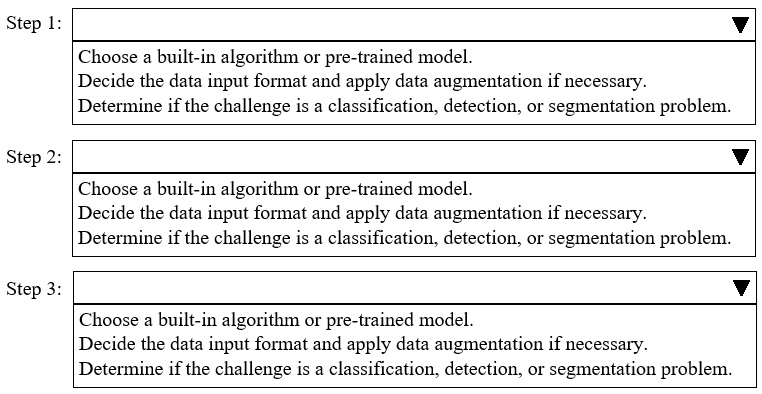
Select and order the steps from the following list to implement the first version of the algorithm. Each step should be selected one time. (Select and order three.)
• Choose a built-in algorithm or pre-trained model.
• Decide the data input format and apply data augmentation if necessary.
• Determine if the challenge is a classification, detection, or segmentation problem.
Community Insight
The common trap is selecting data or algorithm steps before defining the problem type; the correct order is Problem Type → Algorithm Selection → Data Preparation.
This guide explains the correct logical sequence for initiating a machine learning project on Amazon SageMaker, focusing on problem definition before model selection and data preparation.
Learners often jump straight to choosing an algorithm or processing data without first determining if the task is classification, detection, or segmentation, which dictates the required approach.
Community Discussion (2 comments)
Comments & Corrections
No comments yet — spotted an error or have a note? Share it below.
Expert Analysis
Why the Answer Is Correct
The standard machine learning lifecycle begins with understanding the problem statement. In this scenario, you must first 'Determine if the challenge is a classification, detection, or segmentation problem.' This decision is critical because it defines the output format and the metrics needed. Once the problem type is defined, you 'Choose a built-in algorithm or pre-trained model' that supports that specific task (e.g., object detection models for counting people). Finally, after selecting the model architecture, you 'Decide the data input format and apply data augmentation if necessary,' as the preprocessing steps depend entirely on the chosen model's requirements.Why Other Candidate Answers Are Wrong
Choosing an algorithm before knowing the problem type is illogical because not all algorithms solve all problems (e.g., a simple classifier cannot perform bounding box detection). Similarly, deciding on data augmentation before selecting a model is premature, as different models have different input constraints and augmentation needs. The sequence must flow from abstract problem definition to concrete technical implementation.Community Comment Notes
As ChiggaBoy noted, the consensus correctly identifies the order as Problem Definition -> Algorithm Choice -> Data Prep. Another user highlighted that one must 'decide what is the problem, chose an algorithm and then know how to process the data', reinforcing the logical dependency of these steps.Exam Strategy
Always start ML questions by identifying the 'Problem Type' (Classification vs. Regression vs. Detection). Do not select data or infrastructure options until you know exactly what kind of output the model needs to produce.
Frequently Asked Questions
Why does problem type come before algorithm selection?
Because the problem type (e.g., detection) determines the model architecture and output format. You cannot select a valid algorithm without knowing what task it needs to perform.
Can I preprocess data before choosing a model?
No, because different models require different input formats and may need specific augmentations. Preprocessing should be tailored to the selected model's requirements.
Related Analysis
Practice All MLA-C01 Questions
Access 115 questions with complete answers and detailed explanations.
View Full MLA-C01 Practice Test →