Unity Catalog permissions for updating a table without table creation
Short answer
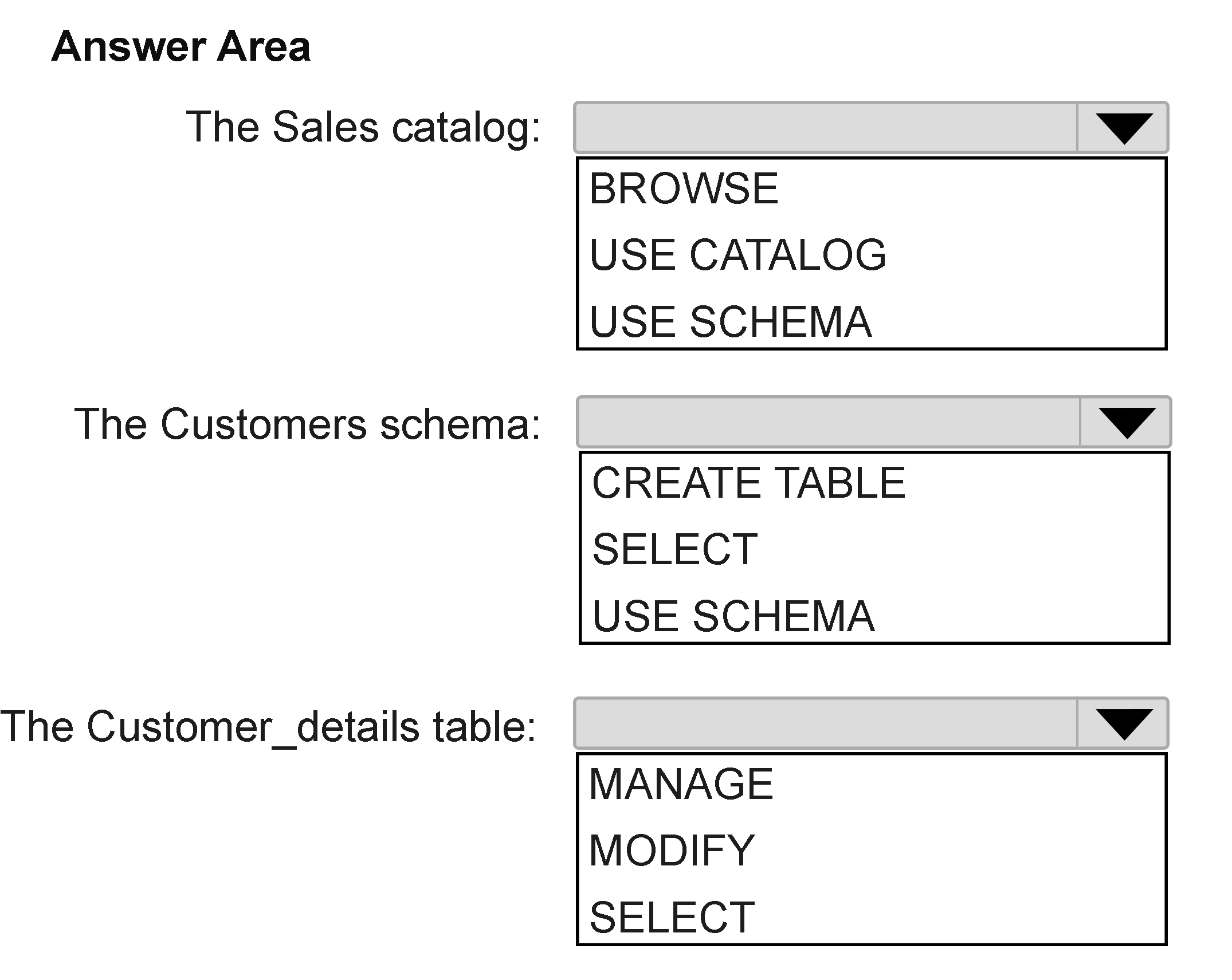
Grant USE CATALOG on the Sales catalog, USE SCHEMA on the Customers schema, and MODIFY on the Customer_details table. Do not grant CREATE TABLE or MANAGE.
Question
You have an Azure Databricks workspace that is attached to a Unity Catalog metastore named metastore1.metastore1 contains:
A catalog named Sales
A schema named Customers in the Sales catalog
A table named Customer_details in the Customers schema
You need to ensure that a user named User1 can update the data in Customer_details. The solution must meet the following requirements:
Ensure that User1 cannot create new tables.
Follow the principle of least privilege.
Which permission should you grant to User1 for each object? To answer, select the appropriate options in the answer area.
NOTE: Each correct selection is worth one point.
Key Takeaways
The question tests least-privilege Unity Catalog privilege mapping, and the main trap is choosing SELECT for table access when only MODIFY permits data changes.
This DP-750 hotspot scenario tests least-privilege Unity Catalog grants for updating data: use USE CATALOG on Sales, USE SCHEMA on Customers, and MODIFY on Customer_details.
Common mistake: Granting SELECT on Customer_details because it grants access to the table; SELECT is read-only, so INSERT, UPDATE, and DELETE require MODIFY instead.
Expert Analysis
Least privilege starts at the containers
To reach Customer_details, User1 needs USE CATALOG on the Sales catalog and USE SCHEMA on the Customers schema. These privileges only let the user traverse the catalog and schema; they do not allow creating tables or schemas. Without them, a table-level grant is not enough in Unity Catalog because access is hierarchical.
The table grant is MODIFY, not SELECT
The most attractive wrong answer is SELECT on Customer_details. It sounds right because the user must work with that table, and SELECT does provide legitimate access for reading it. That is exactly where it stops being correct: the requirement is to update data, and SELECT is read-only. An UPDATE, INSERT, or DELETE statement needs MODIFY, which is the Unity Catalog privilege for changing table data. Choosing SELECT would satisfy visibility but fail the stated task. Learner discussion captures this distinction: SELECT only allows reading, so an update fails without MODIFY.
MANAGE and CREATE TABLE are over-privileged
MANAGE also sounds powerful enough to update data, but it lets User1 grant or revoke privileges and control the object, violating least privilege. A learner note correctly rejects MANAGE for exactly that reason. Likewise, granting CREATE TABLE on Sales or Customers would let User1 create new tables, which the question explicitly forbids. Keep creation rights off both containers.
Final mapping
Grant USE CATALOG on Sales, USE SCHEMA on Customers, and MODIFY on Customer_details. This set allows data changes while preventing table creation and avoiding control over other users’ access. If the requirement were only to query the table, SELECT would be appropriate; because the task is an update scenario, MODIFY replaces it.
Official Reference
This link opens the official vendor documentation in a new tab.
Exam Strategy
Map Unity Catalog access as a path: catalog, then schema, then object. For least-privilege data-change questions, grant USE CATALOG on the catalog and USE SCHEMA on the schema, then choose MODIFY rather than SELECT or MANAGE on the table. Scan the requirement for verbs such as update, create, or manage: update maps to MODIFY, read maps to SELECT, and grant access maps to MANAGE. This prevents over-granting while satisfying the required operation.
Frequently Asked Questions
Why is SELECT insufficient for updating Customer_details?
Are USE CATALOG and USE SCHEMA required in addition to table MODIFY?
Why not grant MANAGE on Customer_details?
Discussion 4 contributions
Compiled from public community threads and reader submissions, lightly edited for clarity. Handles and vote tallies are shown as recorded, and comments reflect the views of individual contributors.
From public community threads 4
-
SarathChandra 👍 10the sales catalog - use catalog the customers schema - use schema the customer_details table - modify
-
fd21624 👍 4the sales catalog - use schema the customers schema - use schema the customer_details table - modify MANAGE Ability to grant/revoke privileges on the object Violates least privilege — User1 would gain control over others' access MODIFY INSERT, UPDATE, DELETE on the table Correct — update data without any schema/table creation rights SELECT Read-only query access Insufficient — cannot update data
-
pietjapie 👍 1The last one is select, the requirement is that User1 can update data. SELECT only allows reading, so with SELECT alone, an UPDATE statement fails with a permission error. MODIFY is the Unity Catalog privilege that allows INSERT, UPDATE, and DELETE. Without it, updating is impossible.
-
pietjapie 👍 1Meant Modify*
Reader comments & corrections
No reader corrections yet — spotted an error or have a note? Share it below.
Related Analysis
Practice All DP-750 Questions
Access 139 questions with complete answers and detailed explanations.
View Full DP-750 Practice Test →