Can a Single-Node Databricks Runtime ML Cluster Use GPUs or Distribute Workloads?
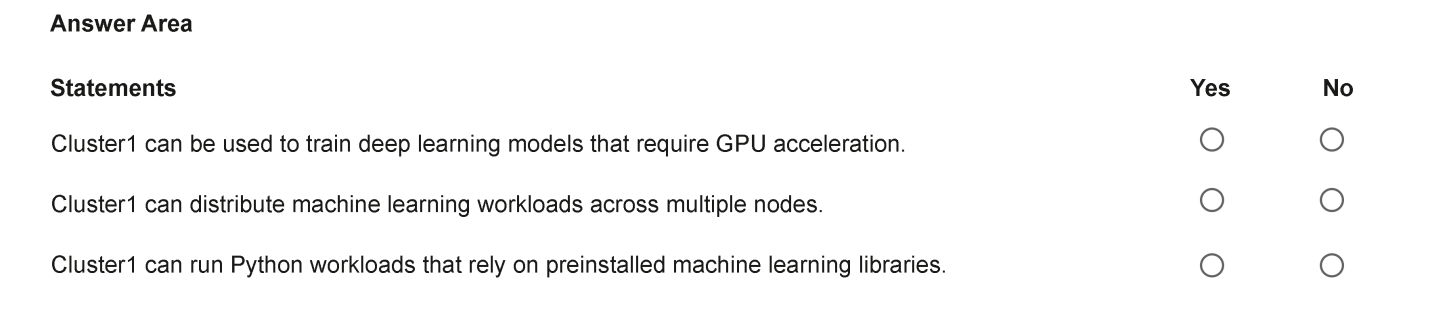
HOTSPOT
You have an Azure Databricks workspace that contains a cluster named Cluster1.
Cluster1 has the following characteristics:
Configured as a single node cluster
Uses a general purpose virtual machine node type
The cluster runtime environment has the following configurations:
Uses Databricks Runtime for Machine Learning (Databricks Runtime ML)
Includes common machine learning libraries
Supports Python workloads
For each of the following statements, select Yes if the statement is true. Otherwise, select No.
NOTE: Each correct selection is worth one point.
Community Insight
The items test whether you can separate runtime capabilities (Databricks Runtime ML libraries and Python support) from hardware and topology limits (general purpose VM node type, single-node cluster with no workers).
This DP-750 hotspot asks you to judge what a single-node Azure Databricks cluster running Databricks Runtime ML can actually do. The page confirms that Python ML workloads are supported, while GPU acceleration and multi-node distribution are not available on this cluster configuration.
Learners see 'Databricks Runtime ML' and assume full ML capability, so they mark GPU acceleration or distributed training as available; the runtime choice says nothing about the VM SKU or node count.
Community Discussion (1 comments)
Comments & Corrections
No comments yet — spotted an error or have a note? Share it below.
Expert Analysis
Why the Answer Is Correct
The cluster is explicitly configured as a single node cluster, so there are no worker nodes and nothing to distribute work across — that statement must be No. It also uses a general purpose virtual machine node type, which by definition has no GPU, so GPU acceleration is No regardless of how many ML libraries Ship with Databricks Runtime ML. Databricks Runtime ML ships common machine learning libraries (scikit-learn, XGBoost, PyTorch, TensorFlow, Hyperopt, MLflow) and supports Python workloads, so the statement about running Python ML workloads is Yes; a single-node Runtime ML cluster is a perfectly valid environment for training and inference on a driver that is large enough. The driver node in a single-node cluster is the compute, and Databricks Runtime ML is supported there.Why Other Candidate Answers Are Wrong
Marking GPU acceleration as Yes is the classic error: Databricks Runtime ML includes GPU-aware libraries and a GPU variant of the runtime exists, but GPU hardware is delivered by the VM SKU, and a general purpose node type has none — you would need a GPU-enabled node type and a GPU runtime. Marking distributed workload execution as Yes is equally wrong because a single-node cluster by definition has no workers; autoscaling, Spark executors and Horovod or TorchDistributor multi-node paths all require worker nodes. Marking Python ML workloads as No would only be defensible on a runtime that lacks the ML libraries, which is not the case here. The reliable decision rule is: runtime family determines libraries and language support, VM type determines hardware accelerators, and node count determines whether distribution is possible.Community Comment Notes
As dgerok noted, the reasoning splits cleanly along the three configuration facts: "The cluster uses a general-purpose VM node type, not a GPU-enabled VM" and "It's configured as a single-node cluster, so there are no worker nodes available for distributed training." The same commenter correctly resolves the third item with Yes because the cluster "uses Databricks Runtime ML, which includes common ML libraries and supports Python workloads." No dissenting answers appear in the discussion, and the three-way reasoning matches the vendor documentation on single-node compute and GPU-enabled compute. Treat the runtime name as a libraries signal only — never as a hardware signal.Official Reference
Exam Strategy
On DP-750 hotspot items, read the cluster attributes line by line and map each statement to exactly one attribute: runtime family for libraries, node type for GPU or hardware accelerators, and node count for distribution. If a statement would require workers or GPU hardware that the scenario never mentions, the answer is almost always No.
Frequently Asked Questions
Does Databricks Runtime ML automatically enable GPU acceleration on a general purpose node type?
No. Databricks Runtime ML includes GPU-capable libraries, but GPU acceleration requires a GPU-enabled VM node type; a general purpose node has no GPU to accelerate.
Why can't a single-node Azure Databricks cluster distribute an ML training workload?
A single-node cluster runs only a driver with no worker nodes, so there are no executors to spread tasks across; distributed training needs a multi-node cluster with workers.