AnswerCorrect answer: D — Because the items are already paired by name, running the deployment pipeline directly overwrites the corresponding target items with the least effort.
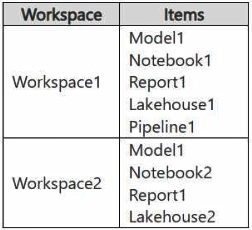
You have two Fabric workspaces named Workspace1 and Workspace2. You have a Fabric deployment pipeline named deployPipeline1 that deploys items from Workspace1 to Workspace2. DeployPipeline1 contains all the items in Workspace1. You recently modified the items in Workspaces1. The workspaces currently contain the items shown in the following table. Items in Workspace1 that have the same name as items in Workspace2 are currently paired. You need to ensure that the items in Workspace1 overwrite the corresponding items in Workspace2. The solution must minimize effort. What should you do? -
Delete all the items in Workspace2, and then run deployPipeline1.
Rename each item in Workspace2 to have the same name as the items in Workspace1.
Back up the items in Workspace2, and then run deployPipeline1.
Run deployPipeline1 without modifying the items in Workspace2. Correct Answer
Community Votes
D
100%
100% of anonymous learners picked answer D.
Votes are pick records left by other test-takers — they are not the verified answer.
Community Insight
Deployment pipelines overwrite only paired items during deployment; you do not need to delete or rename items in the target workspace to refresh the matched ones.
When items in the source and target workspaces are already paired by name, simply running the Fabric deployment pipeline overwrites the corresponding target items. This meets the overwrite requirement with the least effort and leaves unpaired target items untouched.
Deleting all items in the target workspace first, which is extra effort and also removes unpaired items that the requirement did not ask to delete.
Community Discussion (6 comments)
benni_ale👍 3Selected: D
Given minimal effort is required deploying the deploymentpipeline is enough
Zoran_S👍 1Selected: D
I interpret it as, the items in Workspace1 that are paired with Workspace2 need to be overwritten. Those that are not paired remain the same. Therefore just run the deployPipeline1 and everything should be good. If I delete everything in Workspace2 and then run deployPipeline1 then it would be the same as to sync Workspace1 to Workspace2
During deployment, notenook2 will not be deleted from Workspace2. So, you need to delete all items (or at least those not in Workspace1) and then run the pipeline.
Tuki93👍 2Selected: D
I believe the provided answer 'D' is correct.
GHill1982👍 4Selected: D
This requires minimal effort as it has no additional steps such as renaming of deleting items.
Comments & Corrections
No comments yet — spotted an error or have a note? Share it below.
Log in to comment, report an error, or add a note about this question.
Expert Analysis
Why the Answer Is Correct
Fabric deployment pipelines deploy items based on pairing. Items in the source workspace that share a name with items in the target workspace are already paired, so running the pipeline overwrites the corresponding target items. This satisfies 'ensure items in Workspace1 overwrite the corresponding items in Workspace2' with no extra steps, fulfilling the minimize-effort constraint.
Why the Other Options Are Wrong
Option A (delete all items in Workspace2 first) is far more effort and would also delete unpaired items not in scope. Option B (rename items) is unnecessary because the items are already paired by name. Option C (back up Workspace2) adds a step that does not help achieve the overwrite.
Community Comment Notes
Community voting strongly favors D (92). Comments note that minimal effort requires only running the pipeline, and that unpaired items in Workspace2 (such as a notebook only present there) are simply left unchanged.