Which two Fabric warehouse tables should you refresh first?
You have a Fabric data warehouse that contains the following tables.
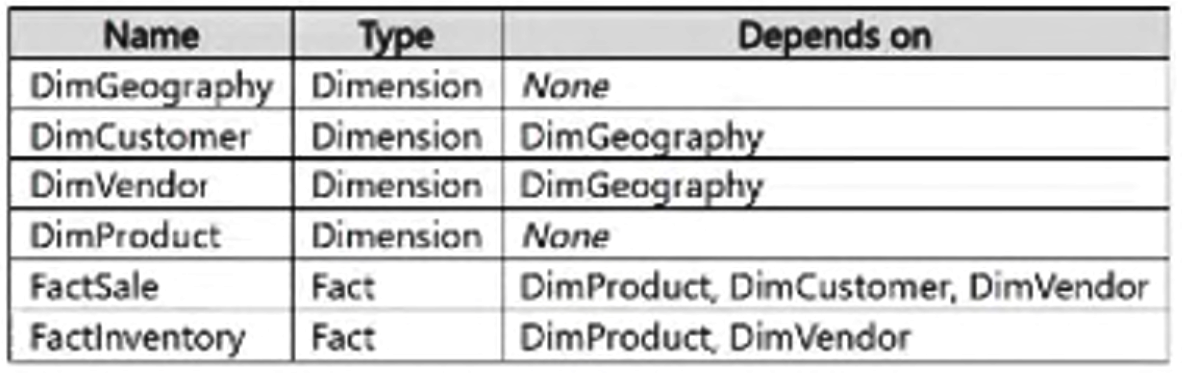 You need to refresh the tables by using an automated pipeline. The solution must ensure that table updates occur in the correct order to maintain referential integrity
Which two tables should you refresh first? Each correct answer presents part of the solution.
NOTE: Each correct selection is worth one point.
You need to refresh the tables by using an automated pipeline. The solution must ensure that table updates occur in the correct order to maintain referential integrity
Which two tables should you refresh first? Each correct answer presents part of the solution.
NOTE: Each correct selection is worth one point.
Community Insight
The question tests dependency ordering for referential integrity; the trap is choosing a familiar dimension such as DimCustomer or a fact table instead of the root dimensions.
In a Fabric data warehouse star schema, dimension tables with no foreign-key dependencies must be loaded before dependent dimensions and fact tables. This page establishes that DimGeography and DimProduct are the correct first two tables (A, C).
Choosing DimCustomer and DimProduct because DimCustomer looks like a core dimension, but DimCustomer depends on DimGeography and cannot be loaded first.
Community Discussion (1 comments)
Comments & Corrections
No comments yet — spotted an error or have a note? Share it below.
Expert Analysis
Why the Answer Is Correct
DimGeography and DimProduct are the dimension tables at the root of the schema: they do not depend on any other table, so they can be loaded first without violating referential integrity. Once their keys exist, DimCustomer can be refreshed because its geography reference is satisfied, and the fact tables can be loaded last. This ordering prevents orphaned foreign-key values in DimCustomer, FactSale, and FactInventory. The source comment from nnnnate captures the rule: "Because they are the parents. Refresh the tables that depend on nothing first."Why the Other Options Are Wrong
DimCustomer is a dimension, but it is not a root: it references DimGeography, so refreshing it before DimGeography can leave customer rows with geography keys that do not yet exist. FactSale and FactInventory are fact tables that reference multiple dimensions, including DimProduct and DimCustomer, so loading either before its dimensions risks orphaned facts. Choosing any fact table as part of the first pair also ignores the need to populate dimension keys before inserting transactions. Only DimGeography and DimProduct are dependency-free parents.Community Comment Notes
The sole community comment, from nnnnate, supports the parent-first logic and explicitly says to "Refresh the tables that depend on nothing first." That matches the star-schema dependency order: root dimensions before dependent dimensions and facts. No comment argues for DimCustomer or a fact table as the first load target. The comment's answer key of AC is consistent with the schema relationships shown in the exhibit.Exam Strategy
Map the schema into parent-child dependencies before answering: root dimensions first, then dependent dimensions, then fact tables. If a dimension has a foreign key to another dimension, it cannot be in your first pair.
Frequently Asked Questions
Why is DimCustomer not refreshed before DimGeography?
DimCustomer has a foreign key to DimGeography, so loading it first could create customer rows that reference missing geography keys.
Should FactSale or FactInventory be included in the first refresh pair?
No. Both are fact tables that depend on dimension keys; loading them first risks orphaned facts and referential-integrity failures.