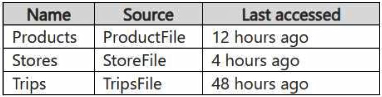
AnswerCorrect answer: C - Products and Stores were accessed within the 24-hour cache retention, while Trips was last accessed 48 hours ago, so only they are served from cache.
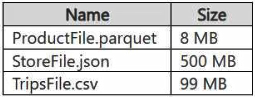
You have a Google Cloud Storage (GCS) container named storage1 that contains the files shown in the following table. You have a Fabric workspace named Workspace1 that has the cache for shortcuts enabled. Workspace1 contains a lakehouse named Lakehouse1. Lakehouse1 has the shortcuts shown in the following table. You need to read data from all the shortcuts. Which shortcuts will retrieve data from the cache? - -
Stores only
Products only
Stores and Products only Correct Answer
Products, Stores, and Trips
Trips only
Community Votes
C
100%
100% of anonymous learners picked answer C.
Votes are pick records left by other test-takers — they are not the verified answer.
Community Insight
Shortcut caching eligibility depends on source type (GCS/S3 supported), file size (up to 1 GB), and cache retention (24 hours by default); a cached file not accessed within the retention window is evicted.
With shortcut caching enabled, GCS files under 1 GB that were read within the cache retention period are served from cache: ProductFile (8 MB, accessed 12 hours ago) and StoreFile (500 MB, 4 hours ago) hit the cache, while TripsFile (99 MB) was last accessed 48 hours ago, beyond the default 24-hour retention, so it re-reads from Google Cloud Storage.
Checking only the source type or file size and forgetting the 24-hour retention: TripsFile is small and on a supported GCS source, but 48 hours since last access means the cached copy expired.
Community Discussion (4 comments)
Tuki93👍 14Selected: C
Shortcut caching can be used to reduce egress costs associated with cross-cloud data access. As files are read through an external shortcut, the files are stored in a cache for the Fabric workspace. Subsequent read requests are served from cache rather than the remote storage provider. Cached files have a retention period of 24 hours. https://learn.microsoft.com/en-us/fabric/onelake/onelake-shortcuts#caching
Kiket2ride👍 2Selected: C
By default is C but now D can also be true. See here: The retention period for cached files can be set from 1-28 days https://learn.microsoft.com/en-us/fabric/onelake/onelake-shortcuts#caching
henryphchan👍 2Selected: C
Data within 1GB and accessed less than 24 hours will be cached
Bharat👍 2Selected: D
I think that the correct answer is D instead of C because the caching is enabled for ALL types of files in a Lakehouse whether they are Parquet, JSON, or CSV.
Comments & Corrections
No comments yet — spotted an error or have a note? Share it below.
Log in to comment, report an error, or add a note about this question.
Expert Analysis
Why the Answer Is Correct
All three shortcuts point to files in a GCS container, a supported caching source, and all files are under the 1 GB caching limit (8 MB, 500 MB, 99 MB). The discriminator is retention: cached files are kept for a retention period (24 hours by default) and subsequent reads within that window are served from cache. ProductFile was accessed 12 hours ago and StoreFile 4 hours ago, so both are still cached; TripsFile was last accessed 48 hours ago, beyond the default 24-hour retention, so its cached copy expired and reading it fetches from Google Cloud Storage.
Why the Other Options Are Wrong
Options A, B, and E each drop one of the two still-cached shortcuts. Option D (all three) ignores the retention window - TripsFile's cache entry expired after 48 hours without access.
Community Comment Notes
The community strongly favors C (90). Tuki93 (14 likes) cites the shortcuts documentation stating cached files have a 24-hour retention period, and henryphchan summarizes the rule as files under 1 GB accessed within 24 hours are cached. Kiket2ride notes retention is now configurable from 1 to 28 days, but the workspace here only says caching is enabled, so the 24-hour default applies.
 -
-