What Actually Deploys from Workspace1_DEV to Workspace1_TEST in a Fabric Deployment Pipeline?
HOTSPOT
You have a Fabric workspace named Workspace1_DEV that contains the following items:
10 reports
Four notebooks
Three lakehouses
Two data pipelines
Two Dataflow Gen1 dataflows
Three Dataflow Gen2 dataflows
Five semantic models that each has a scheduled refresh policy
You create a deployment pipeline named Pipeline1 to move items from Workspace1_DEV to a new workspace named Workspace1_TEST.
You deploy all the items from Workspace1_DEV to Workspace1_TEST.
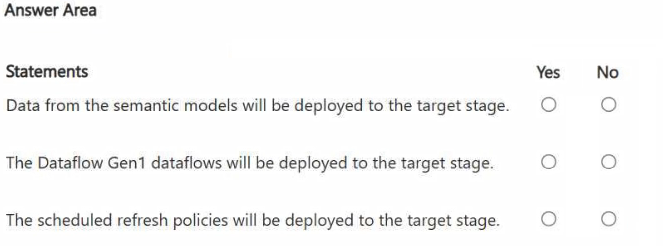
For each of the following statements, select Yes if the statement is true. Otherwise, select No.
NOTE: Each correct selection is worth one point.
Community Insight
The item tests which item properties survive a deployment — definitions and supported item types move, data and stage-specific settings like refresh schedules do not — and the trap is assuming Dataflow Gen1 is excluded because Gen2 gets all the attention.
Fabric deployment pipelines promote item definitions, not data: semantic model data and scheduled refresh policies stay in the source stage, while Dataflow Gen1 items are still deployable alongside Dataflow Gen2. This page settles the three Workspace1_DEV to Workspace1_TEST statements as No, Yes, No.
Learners often answer "No" to the Dataflow Gen1 statement because the documentation's supported-items table leads with Dataflow Gen2 and the workspace lists both flow generations; they treat Gen1 as legacy and quietly skip the two Gen1 dataflows.
Community Discussion (30 comments)
Comments & Corrections
No comments yet — spotted an error or have a note? Share it below.
Expert Analysis
Why the Answer Is Correct
A deployment pipeline is a metadata promotion mechanism, and the Fabric documentation states plainly that data is not copied between stages — only item definitions travel, so the five semantic models arrive in Workspace1_TEST as structures that must be refreshed there before they hold any rows. The same documentation lists Dataflow Gen1 (the Power BI dataflow item) among supported item types, so the two Gen1 dataflows in Workspace1_DEV are deployed to Workspace1_TEST just like the three Dataflow Gen2 dataflows and the two data pipelines. Scheduled refresh policies are stage-scoped settings, not part of the item definition, so the refresh schedules attached to the five semantic models are not carried over and must be reconfigured in the test workspace. That yields No for data, Yes for Dataflow Gen1, and No for refresh schedules.Why Other Candidate Answers Are Wrong
Answering Yes to the data statement confuses deployment with a data copy or a refresh — nothing in the pipeline moves rows or triggers the target models to load. Answering No to Dataflow Gen1 assumes only Gen2 is supported; Gen1 dataflows have been deployable since Power BI deployment pipelines and remain a supported Fabric item, so the flows themselves land in the target stage even though their stored data and connection credentials may need attention. Answering Yes to the refresh statement ignores that each stage is an independent workspace with its own settings, which is exactly why the exam pairs semantic models with refresh policies in the scenario.Community Comment Notes
SamuComqi, the highest-voted commenter, works straight from the deployment-process doc and concludes that "only metadata" reaches the target stage while "Gen1 dataflows will be deployed", and that refresh schedules will not be deployed — matching the No/Yes/No verdict. GHill1982 pushed back on the anti-Gen1 camp by pointing at the supported-items list and describing Gen1 as the Power BI Dataflows item, while Acrious summarized the same pattern as "N, Y, N" with a note that connections may need fixing. Juanes55 and Marco44 argue that only Dataflow Gen2 is supported and warn that Gen1 must be recreated manually, which is the central distractor to reject. Several voters such as fassil and 5dcd3a8 correctly quote "Data isn't copied. Only metadata is copied" but then extend that reasoning to Gen1 support, which is where their answer chain breaks.Official Reference
Exam Strategy
Separate the statements into "item definition", "item type supported", and "stage-specific setting" before answering — data and refresh schedules belong to the last two buckets and almost always answer No. For any legacy-looking item such as Dataflow Gen1, check the supported-items table rather than assuming deprecation.
Frequently Asked Questions
Do I need to refresh the five semantic models in Workspace1_TEST after the deployment pipeline runs?
Yes. Only the model definition is deployed, so the models arrive empty in the target stage and you must refresh them (and recreate the refresh schedule) to load data.
Are the two Dataflow Gen1 dataflows really promoted to Workspace1_TEST alongside the three Dataflow Gen2 flows?
Yes, Dataflow Gen1 is a supported item type in Fabric deployment pipelines, so the flows deploy as definitions — but verify connections and credentials per stage after deployment.