How to Model Order Items by Date, Product, and Customer?
HOTSPOT
You have the source data model shown in the following exhibit.
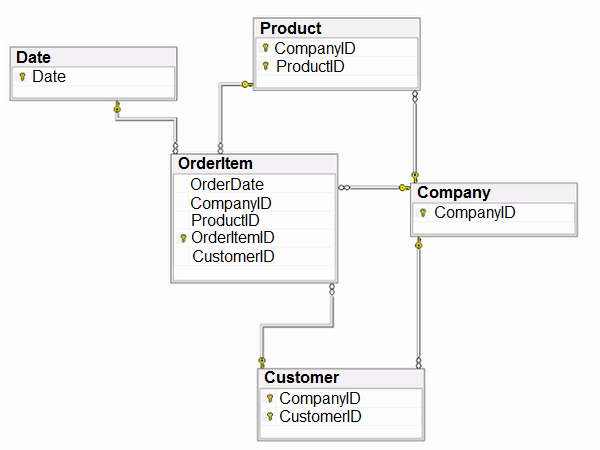 The primary keys of the tables are indicated by a key symbol beside the columns involved in each key.
You need to create a dimensional data model that will enable the analysis of order items by date, product, and customer.
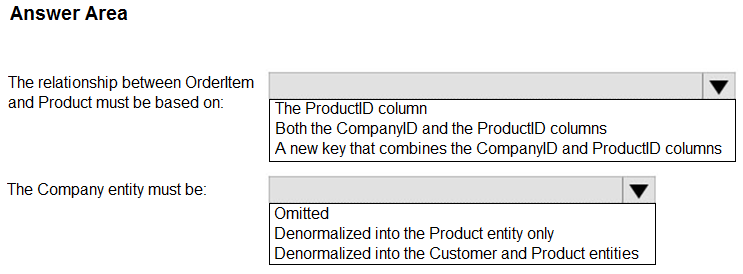
What should you include in the solution? To answer, select the appropriate options in the answer area.
NOTE: Each correct selection is worth one point.
Community Insight
It tests whether you know Power BI relationships are single-column and that partial primary-key joins are invalid; the trap is joining on ProductID alone or assuming the Company table can simply be deleted.
This DP-600 hotspot asks how to turn a snowflake-style source with a composite Product key (ProductID + CompanyID) into a dimensional model for analyzing order items by date, product, and customer. The solution is a new combined CompanyID+ProductID key for the OrderItem-to-Product relationship, with the Company entity denormalized into both the Customer and Product tables.
The most common wrong approach is relating OrderItem to Product on ProductID only, which matches one product row per company incorrectly and silently duplicates or misallocates measures, because ProductID is not unique without CompanyID.
Community Discussion (36 comments)
Comments & Corrections
No comments yet — spotted an error or have a note? Share it below.
Expert Analysis
Why the Answer Is Correct
The Product table's primary key is the composite of ProductID and CompanyID, so ProductID alone does not uniquely identify a row. Because the Power BI/Analysis Services model view only permits single-column relationships, the correct fix is to add a calculated key column that concatenates CompanyID and ProductID in both OrderItem and Product and use that column for the relationship. Company attributes are then denormalized into both the Customer and Product entities, which preserves company information while allowing the Company table to be removed from the star schema. This yields clean, single-hop dimensions for date, product, and customer analysis.Why Other Candidate Answers Are Wrong
Selecting only ProductID for the relationship fails because ProductID repeats across companies, so the join would fan out or misdirect rows and produce wrong order-item aggregates. Choosing to join on both the ProductID and CompanyID columns directly is not implementable in the Model view, since multi-column relationships are unsupported there (a Power Query merge would be needed instead, which is not this answer area). Ignoring or merely omitting the Company entity without denormalizing it discards company attributes and leaves the composite key problem unresolved, breaking the dimensional grain.Community Comment Notes
MYPE observed that "there is no possibility to create a relationship based on 2 columns" and that this must be done in Power Query instead, supporting the combined-key choice. metiii argued that "you cannot just reference a part of the primary key," warning that a ProductID-only relationship would be wrong. thuss and IK247 both favored denormalizing company data so the CompanyID no longer drives the join, while d47320d countered that a two-column join was still required. zerone72 and 2dc6125 pushed the opposite view that the company table could simply be omitted, but that ignores the composite key and the attributes the Company table carries.Exam Strategy
For hotspot items, first identify the key grain of every table and check whether any primary key is composite; then remember the Model view only supports single-column relationships, so composite keys must be flattened into a surrogate/combined column before relating tables.
Frequently Asked Questions
Why can't I relate OrderItem to Product using only ProductID?
ProductID is only part of Product's composite primary key, so it repeats across companies and would not uniquely match each row, producing incorrect order-item analysis.
Why does the Company table need to be denormalized into Customer and Product?
Denormalizing company attributes into both tables preserves the data while letting you remove the Company table, keeping a simple star schema for analysis by date, product, and customer.
Related Analysis
Practice All DP-600 Questions
Access 115 questions with complete answers and detailed explanations.
View Full DP-600 Practice Test →