AWS Glue DataBrew NEST_TO_MAP Transformation
A company receives .csv files that contain physical address data. The data is in columns that have the following names: Door_No, Street_Name, City, and Zip_Code. The company wants to create a single column to store these values in the following format: Which solution will meet this requirement with the LEAST coding effort? - 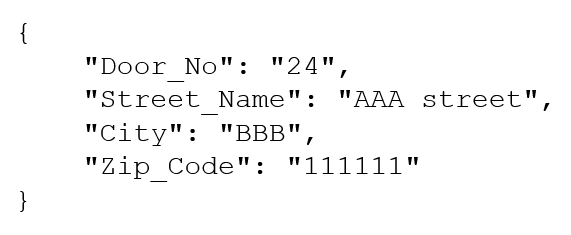
Community Votes
100% of anonymous learners picked answer B. Votes are pick records left by other test-takers — they are not the verified answer.
Community Insight
The key insight is distinguishing between NEST_TO_ARRAY (which creates an ordered list of objects) and NEST_TO_MAP (which creates a key-value JSON object), as the target format requires key-value pairs.
This question tests the use of AWS Glue DataBrew's NEST_TO_MAP transformation to consolidate multiple columns into a single JSON object with minimal coding.
Many learners choose Option A (NEST_TO_ARRAY) because they focus on the square brackets in the example image, failing to recognize that the content inside represents key-value pairs rather than a simple array of values.
Community Discussion (6 comments)
Comments & Corrections
No comments yet — spotted an error or have a note? Share it below.
Expert Analysis
Why the Answer Is Correct
Option B is correct because the required output is a JSON object where each address component (Door_No, Street_Name, etc.) serves as a key and its value is the corresponding data. The NEST_TO_MAP transformation in AWS Glue DataBrew specifically converts selected columns into a map (JSON object) with key-value pairs, which matches the desired structure {"Door_No": "123",...}. This requires zero custom code, satisfying the 'least coding effort' constraint.Why the Other Options Are Wrong
Option A (NEST_TO_ARRAY) produces an array of objects like [{"key": "Door_No", "value": "123"}], which does not match the flat key-value JSON object shown in the prompt. Option C (PIVOT) rotates column headers into row values or vice versa, which is unrelated to creating a nested JSON structure from existing columns. Option D involves writing Python code in Lambda, which violates the 'least coding effort' requirement compared to using a visual tool like DataBrew.Community Comment Notes
The community largely agreed on Option B. As user FuriouZ noted, "NEST_TO_ARRAY would result in: [ {"key": "key1", "value": "value1"}...] while NEST_TO_MAP results: { "key1": "value1"...}". User Ousseyni correctly identified that DataBrew allows easy transformation without extensive coding. Although some users like GiorgioGss argued for A due to the visual appearance of brackets, the internal structure is clearly a map, not an array of primitives.Official Reference
Exam Strategy
When asked for 'least coding effort', prioritize managed services with visual interfaces or built-in transformations over custom scripting. Always inspect the exact data structure requested; if it looks like a dictionary or JSON object with keys, look for MAP-based transformations.
Frequently Asked Questions
What is the difference between NEST_TO_ARRAY and NEST_TO_MAP in DataBrew?
NEST_TO_ARRAY creates an ordered list of key-value objects, while NEST_TO_MAP creates a single JSON object (map) where columns become keys and values.
Why is PIVOT not suitable for this task?
PIVOT is used to rotate column headers into rows or vice versa, not to combine multiple columns into a single nested JSON structure.
Related Analysis
Practice All DEA-C01 Questions
Access 100 questions with complete answers and detailed explanations.
View Full DEA-C01 Practice Test →