Identifying Data Redundancy in Derived Columns
Short answer
A Redundancy is the best explanation for the data issue with TypeID, as it stores information derivable from existing Type and ID columns, violating normalization principles.
Question
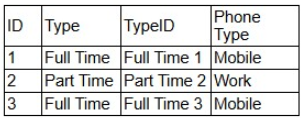
Which of the following best explains the data issue with TypeID?
Key Takeaways
The main trap is confusing redundancy (unnecessary derived data) with duplication (identical rows); recognizing that a column calculable from others is redundant is key.
This question tests the ability to identify data quality issues, specifically redundancy, in a dataset containing derived columns. The correct answer is A, highlighting how storing composite values unnecessarily impacts data integrity.
Common mistake: Option D (Duplication) is the most plausible wrong answer. Candidates often see repeated values or similar-looking entries and assume 'duplication' without analyzing whether the column itself is structurally unnecessary due to derivation from other fields.
Expert Analysis
The core issue lies in understanding data normalization principles within a relational or analytical dataset. The exhibit (implied by the comments) shows a column TypeID that is a composite of the Type and ID columns (e.g., "Full Time 1" derived from Type="Full Time" and ID=1).
Redundancy (A) is the correct diagnosis. In database theory, redundancy occurs when data can be calculated from other existing data. Since TypeID adds no new information beyond what is already present in Type and ID, it violates normalization rules (specifically 1NF/2NF depending on context). This creates risks of update anomalies where one part changes but the composite does not. The first comment correctly identifies this: "It adds no new information... Storing the same data again... is redundancy."
Duplication (D) is the most attractive distractor. A commenter argues that "the same ID appears more than once," implying duplicate rows. However, in a typical table structure with unique identifiers, having the same value in a single column doesn't necessarily mean the row is duplicated unless the primary key is violated. More importantly, even if there were duplicate rows, the specific structural flaw of creating a derivative column like TypeID is a classic textbook example of redundant data. Duplication refers to identical records; redundancy refers to unnecessary data fields. The question asks about the issue with TypeID specifically, pointing to its nature as a derived, non-normalized field.
Therefore, the issue is that TypeID is redundant because it is functionally dependent on other columns.
Exam Strategy
When analyzing table structures, always check if any column's content can be fully reconstructed from other columns using simple concatenation or calculation. If yes, that column is redundant. Do not confuse this with duplication, which involves identical rows. Look for functional dependencies between fields to identify normalization violations quickly during the exam.
Frequently Asked Questions
What is the difference between data redundancy and data duplication?
Why is redundant data bad for analysis?
Community Votes
50% of anonymous learners picked answer A. Votes are pick records left by other test-takers — they are not the verified answer.
Discussion 2 contributions
Compiled from public community threads and reader submissions, lightly edited for clarity. Handles and vote tallies are shown as recorded, and comments reflect the views of individual contributors.
From public community threads 2
-
6b7911d 👍 1 Answered AA is correct. TypeID is just the Type column and the ID column joined together, so “Full Time” plus “1” gives “Full Time 1.” It adds no new information because every value can be derived from two columns already in the table. Storing the same data again in another field is redundancy. It wastes space, and if Type changes without TypeID being updated, the two columns can fall out of sync.
-
Amelia233 👍 1 Answered DThe issue with TypeID is that the same ID appears more than once in the table. This means the data contains duplicate values. A. Redundancy → Unnecessary repeated information. B. Outlier → A value that is significantly different from others. C. Missing data → Required values are absent. D. Duplication ✅ → The same TypeID appears multiple times. Correct Answer: D. Duplication
Reader comments & corrections
No reader corrections yet — spotted an error or have a note? Share it below.
Related Analysis
Practice All DA0-002 Questions
Access 100 questions with complete answers and detailed explanations.
View Full DA0-002 Practice Test →