Which Facts Table Should Be Used for Incident Close Code Breakdown in ServiceNow PA?
Consider this scenario: 1. You are working with a default ServiceNow instance. 2. You need to configure a Breakdown source and a Breakdown for the Close code field in order to analyze incident data by Close codes. Which of the following is the correct Facts table to use in the Breakdown source for Close code? - 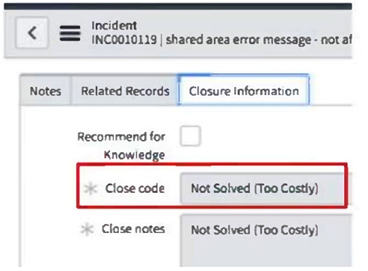
Community Votes
100% of anonymous learners picked answer B. Votes are pick records left by other test-takers — they are not the verified answer.
Community Insight
This question tests understanding of how PA breakdown sources map choice fields: the facts table must list the possible field values, not the records containing the field. The trap is assuming the Incident table is the facts table simply because Close code is an Incident field.
For a ServiceNow Performance Analytics breakdown source based on the Incident Close code field, the correct table is sys_choice. Community consensus confirms the breakdown source should reference the Choice table because close code values are stored as sys_choice entries.
Choosing Incident [incident] is the most common mistake. Although Close code appears on Incident records, a breakdown source for a choice field must use the Choice [sys_choice] table, which stores the actual list of possible close code values, not each incident record.
Community Discussion (3 comments)
Comments & Corrections
No comments yet — spotted an error or have a note? Share it below.
Expert Analysis
Why the Answer Is Correct
The correct answer is B, Choice [sys_choice]. In ServiceNow Performance Analytics, a breakdown source defines a list of possible breakdown elements. For a field like Incident Close code that is backed by a choice list, the elements come from the sys_choice table, filtered by table, element, and language. The documentation example for Incident.Category similarly uses the Choice table as the source of breakdown elements, with Sys ID identifying each choice.
The suggested answer aligns with ServiceNow documentation and was confirmed by a highly upvoted community comment. The comment notes: “Always use a facts table with a field that has a unique value for every record, usually Sys ID. For example, the Incident.Category breakdown source takes its elements from the Choice table.” This is exactly the pattern needed for Close code.
Why the Other Options Are Wrong
Option A, Close Code [sys_close_code], is not a standard ServiceNow table used as a breakdown source facts table. The system table for close code values is sys_choice, not sys_close_code. Option C, Incident [incident], is tempting because Close code is a field on the Incident table, but Incident rows are not distinct breakdown elements. Using Incident would produce one breakdown per incident rather than per close code value. Option D, Task [task], is too generic and does not specifically represent the close-code field choices; it also is not the documented pattern for choice-based breakdowns.
Community Comment Notes
One comment directly quotes ServiceNow guidance and supports option B, explaining that breakdown sources for choice fields use the Choice table and filter by the target table, field, and language. Another comment provides the official ServiceNow documentation link for defining a breakdown source. A lower-ranked comment argued for Incident, but it misidentifies the role of the facts table: a breakdown source must supply distinct values for the breakdown, not the records whose fields are being broken down.
Official Reference
Exam Strategy
On exam questions about Breakdown sources, first ask: “Does the target field have a limited set of choices?” If yes, the source table is usually sys_choice, not the business table like Incident. Look for the words 'Choice' or 'sys_choice' in the options and remember that ServiceNow pulls breakdown elements from a facts table where each row represents one possible value.
Related Analysis
Practice All CAS-PA Questions
Access 79 questions with complete answers and detailed explanations.
View Full CAS-PA Practice Test →