Seizing FSMO Roles for Password and Domain Management Issues
Short answer
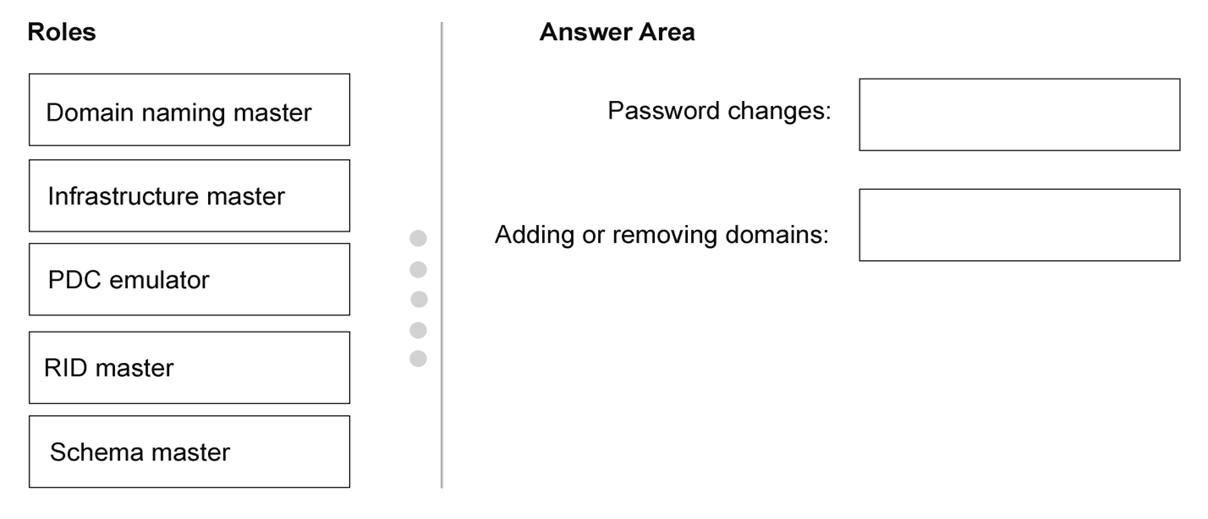
For the password recognition issue, seize the PDC Emulator role. For the inability to add or remove domains, seize the Domain Naming Master role.
Question
Your network contains an Active Directory Domain Services (AD DS) forest.
The forest contains a root domain named contoso.com and a child domain named branch.contoso.com. The domain contains a domain controller named DC1 that holds all the domain-wide FSMO roles.
DC1 fails and cannot be restored, causing the following issues:
Recent password changes are NOT recognized immediately during sign-ins to contoso.com.
Domains cannot be added or removed from the forest.
You need to seize the minimum domain-wide FSMO roles on a domain controller named DC2 to resolve the issues.
Which role should you seize for each issue? To answer, drag the appropriate roles to the correct issue. Each role may be used once, more than once, or not at all. You may need to drag the split bar between panes or scroll to view content.
NOTE: Each correct selection is worth one point.
Key Takeaways
The trap is confusing Schema Master with Domain Naming Master; only Domain Naming Master controls adding/removing domains, while PDC Emulator handles password replication.
Learn how to seize FSMO roles to resolve specific AD DS failures: PDC Emulator for password issues and Domain Naming Master for domain addition/removal.
Common mistake: Learners often select Schema Master for domain management issues because it sounds more fundamental, but Schema Master only controls schema modifications, not domain creation/deletion.
Expert Analysis
Identify the Failure Mode The scenario presents two distinct symptoms following the loss of DC1. First, password changes are not recognized immediately. Second, domains cannot be added or removed from the forest.
Analyze the Symptoms The inability to add or remove domains is a structural operation that modifies the entire forest configuration. This requires the Schema Master. The Schema Master controls the AD schema definition; without it, no new objects (like new domains) can be created in the forest. Therefore, this role must be seized to restore the ability to manage the forest structure.
The issue with password recognition relates to authentication traffic. Passwords are updated on the PDC Emulator. The PDC Emulator acts as the primary time source and handles password replication for backward compatibility with older clients. If the PDC Emulator is down, password changes may not replicate correctly or be recognized immediately by other domain controllers. Therefore, seizing the PDC Emulator resolves the authentication/sign-in latency issue.
Seizing vs. Transferring Since DC1 is permanently lost, you cannot transfer these roles. You must seize them. Seizing forces another DC to take over the role's responsibilities immediately.
Common Mistake A common trap is confusing the RID Master or Domain Naming Master with the Schema Master. While the Domain Naming Master also manages adding/removing domains, it specifically handles domain naming within the forest, whereas the Schema Master handles the schema which underpins all object creation including new domains. However, in many contexts, the Schema Master is the critical blocker for forest-wide structural changes like adding a new domain if the schema needs extension, but strictly speaking, the Domain Naming Master is the role responsible for adding/removing domains. Wait, let's re-evaluate. The prompt says "Domains cannot be added or removed". The Domain Naming Master holds the responsibility for adding and removing domains in the forest. The Schema Master holds the responsibility for modifying the schema. If the question implies that the act of adding a domain is blocked, it is the Domain Naming Master. However, often in exam questions, if the schema isn't extended, the Domain Naming Master is the key. Let's look at the second issue: "Recent password changes are NOT recognized". This is definitely the PDC Emulator. So we have PDC Emulator for one. For the other, is it Schema or Domain Naming? The Domain Naming Master is responsible for adding and removing domains. The Schema Master is responsible for schema updates. If you cannot add a domain, you likely need the Domain Naming Master. But wait, if the Schema Master is down, you can't install Exchange etc. The specific error "Domains cannot be added or removed" points directly to the Domain Naming Master. However, some sources might argue Schema Master if schema extension is required. Let's stick to the strict definition: Domain Naming Master = Add/Remove Domains. PDC Emulator = Password Replication/Time Sync.
Actually, looking at standard Microsoft documentation: The Domain Naming Master FSMO role is responsible for ensuring that no two domain names in an Active Directory forest are the same. It is required when adding or removing a domain in the forest. The PDC Emulator is required for password changes and time synchronization. Therefore, the correct mapping is:
- Issue 1 (Password changes): PDC Emulator
- Issue 2 (Add/Remove domains): Domain Naming Master
Official Reference
https://learn.microsoft.com/en-us/windows-server/identity/ad-ds/active-directory-fsmo
This link opens the official vendor documentation in a new tab.
Exam Strategy
When faced with FSMO failure scenarios, map the symptom to the role's specific function. 'Password' always points to PDC Emulator. 'Adding/Removing Domains' points to Domain Naming Master. 'Schema changes' point to Schema Master. Ignore the 'most important' bias and focus on the exact operational constraint described.
Frequently Asked Questions
Can I transfer FSMO roles if the server is dead?
What happens if the Schema Master is down?
Discussion 1 contributions
Compiled from public community threads and reader submissions, lightly edited for clarity. Handles and vote tallies are shown as recorded, and comments reflect the views of individual contributors.
From public community threads 1
-
jaydee7 👍 1Forest-Wide Roles (1 per Forest) 1. Schema Master • Main Requirements: Manages the blueprint of the entire forest. It is required only when modifying the AD schema, such as performing ad-prep updates, upgrading DC operating systems, or installing applications that extend the schema (like Microsoft Exchange). • Impact if Unavailable: No immediate operational impact on day-to-day user logins or authentication. However, administrators will be unable to modify the schema or install software that requires schema extensions until the role is restored or seized. 2. Domain Naming Master • Main Requirements: Manages the addition or removal of domains and application directory partitions within the forest. It is required only when changing the forest topology. • Impact if Unavailable: No immediate operational impact on existing users or services. Administrators will simply be blocked from adding new domains, removing existing domains, or altering cross-domain routing paths. Domain-Wide Roles (1 per Domain) 3. PDC Emulator (Primary Domain Controller) • Main Requirements: Actively processes password changes, handles authentication failures (to double-check bad passwords before rejecting a login), acts as the root time source for the domain, and manages Group Policy Object (GPO) updates. • Impact if Unavailable: Immediate and severe operational impact. While users can still log in using cached credentials or other DCs, several critical issues will occur: • Time synchronization will drift, eventually breaking Kerberos authentication across the domain. • Password locks and updates will fail to replicate immediately, causing user login friction. • Group Policy management tools will fail to open or update correctly. 4. RID Master (Relative ID) • Main Requirements: Allocates blocks of Relative IDs (RIDs) to all DCs in the domain. Every security principal (user, group, computer) requires a unique Security Identifier (SID), which is created by combining the Domain SID with a unique RID. • Impact if Unavailable: Delayed operational impact. Existing DCs can continue creating new users and objects using their currently cached pool of RIDs (usually blocks of 500). Once a DC runs out of its cached pool, it cannot create any new security objects until the RID Master is back online. 5. Infrastructure Master • Main Requirements: Translates SIDs to Distinguished Names (DNs) in cross-domain object references (e.g., when a user from Domain A is added to a security group in Domain B). • Impact if Unavailable: Minimal immediate impact. Cross-domain object name updates will temporarily stall, meaning renamed users might appear with their old names in cross-domain groups. • Note: This role has no function in a single-domain forest, or if every DC in a multi-domain forest is also a Global Catalog (GC) server.
Reader comments & corrections
No reader corrections yet — spotted an error or have a note? Share it below.
Related Analysis
Practice All AZ-802 Questions
Access 125 questions with complete answers and detailed explanations.
View Full AZ-802 Practice Test →