Minimum DHCP Scopes and Relays for Multi-VLAN Deployment
Short answer
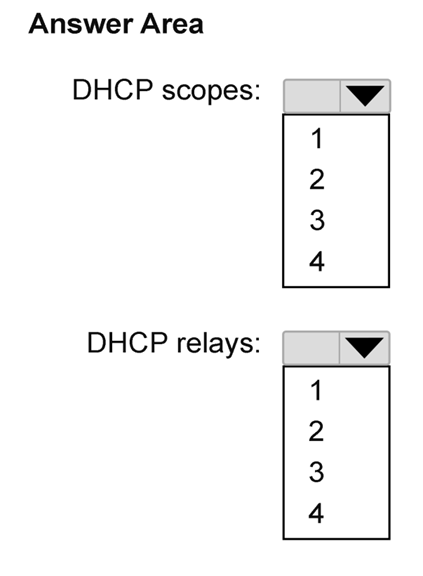
Create 2 DHCP scopes (one for each client VLAN subnet) and 2 DHCP relays (one for each client VLAN to forward requests to the datacenter).
Question
Your network contains two VLANs for client computers and one VLAN for a datacenter. Each VLAN is assigned an IPv4 subnet. Currently, all the client computers use static IP addresses.
You plan to deploy a DHCP server to the VLAN in the datacenter.
You need to use the DHCP server to provide IP configurations to all the client computers.
What is the minimum number of scopes and DHCP relays you should create? To answer, select the appropriate options in the answer area.
NOTE: Each correct selection is worth one point.
Key Takeaways
The trap is assuming one scope/relay suffices for all clients; however, each distinct client subnet requires its own scope and a dedicated relay agent to route broadcasts to the central server.
Determine the minimum DHCP scopes and relays needed when clients are in multiple VLANs separate from the DHCP server location. Requires 2 scopes and 2 relays.
Common mistake: Learners often select 1 scope and 1 relay, failing to recognize that each unique client subnet requires a dedicated scope and that broadcasts cannot cross routers without a relay per source subnet.
Expert Analysis
The scenario involves a DHCP server deployed in a datacenter VLAN, while client computers reside in two separate client VLANs. DHCP relies on UDP broadcast packets (Discover/Offer) which are not routed by default across subnets. Therefore, the network architecture requires mechanisms to bridge these isolated Layer 3 segments.
First, consider the DHCP Scopes. A scope defines the pool of IP addresses available for lease within a specific subnet. Since there are two distinct client VLANs, each with its own IPv4 subnet, you must create one scope per client subnet to provide valid IP configurations. The datacenter VLAN uses static IPs and does not require a DHCP scope. Thus, the minimum number of scopes is 2.
Second, consider the DHCP Relays. Because the DHCP server is in a different subnet than the clients, the initial broadcast requests from clients will not reach the server. You need a DHCP Relay Agent (typically configured on the router or Layer 3 switch interface facing each client VLAN) to forward these broadcasts as unicast packets to the central DHCP server. Since there are two client VLANs separated from the datacenter, you need one relay agent for each client VLAN to ensure their requests are forwarded correctly. Thus, the minimum number of relays is 2.
Comments confirm this logic: "The two client VLANs are on separate subnets, needing one scope each... Each client VLAN needs one relay agent." This aligns with standard Windows Server networking principles where scopes match client subnets and relays exist at each source subnet boundary.
Exam Strategy
When asked about DHCP infrastructure, always map the number of client subnets to the number of scopes. Then, count the number of client subnets separated from the server to determine the required relay agents. Remember: One Scope = One Client Subnet; One Relay = One Source Subnet requiring service.
Frequently Asked Questions
Why do I need a relay agent if the DHCP server is already on the network?
Can I use one scope for both client VLANs?
Discussion 2 contributions
Compiled from public community threads and reader submissions, lightly edited for clarity. Handles and vote tallies are shown as recorded, and comments reflect the views of individual contributors.
From public community threads 2
-
fabiomartinsnet 👍 1i think the provided answer is wrong... Because the client computers reside in two distinct VLANs separated from the datacenter where the DHCP server is deployed, so you need at least two DHCP scopes (one dedicated to each client subnet) and two DHCP relays (one per client VLAN to forward DHCP broadcast requests across the subnets to the central DHCP server).
-
linux_admin 👍 12 Scopes: The two client VLANs are on separate subnets, needing one scope each. The datacenter uses static IPs, so it needs no scope. 2 Relays: DHCP broadcasts cannot cross routers to reach the datacenter. Each client VLAN needs one relay agent to forward requests.
Reader comments & corrections
No reader corrections yet — spotted an error or have a note? Share it below.
Related Analysis
Practice All AZ-802 Questions
Access 125 questions with complete answers and detailed explanations.
View Full AZ-802 Practice Test →