Configure VNet peering and a storage service endpoint for AVD host pools
Short answer
Configure virtual network peering between VNet1 and VNet3 so Pool1 reaches Server1 over the Microsoft backbone, and enable a Microsoft.Storage service endpoint on VNet2 so Pool2 reaches storage1 over the Microsoft backbone.
Question
You have an Azure subscription that contains the resources shown in the following table.
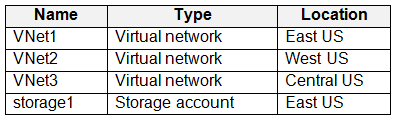
You have a virtual machine named Server1 that runs Windows Server and is connected to VNet3.
You need to deploy the Azure Virtual Desktop host pools shown in the following table.

The solution must meet the following requirements:
• The session hosts in Pool1 must access Server1 via the Microsoft backbone network.
• The session hosts in Pool2 must access storage1 via the Microsoft backbone network.
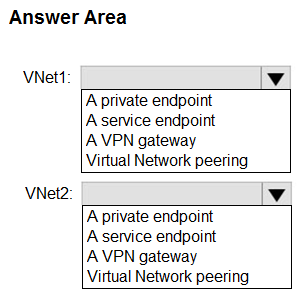
What should you configure on the virtual networks? To answer, select the appropriate options in the answer area.
NOTE: Each correct selection is worth one point.
Key Takeaways
It tests distinguishing IaaS VM connectivity (VNet peering) from PaaS storage connectivity (service endpoint), with the trap of treating Server1 as a service-endpoint target.
This AZ-140 hotspot tests Microsoft backbone connectivity for Azure Virtual Desktop: Pool1 needs VNet peering between VNet1 and VNet3 for Server1, and Pool2 needs a Microsoft.Storage service endpoint on VNet2 for storage1.
Common mistake: The common mistake is selecting a service endpoint or private endpoint for VNet1 to reach Server1; service endpoints target supported Azure PaaS services, not a Windows Server VM in VNet3, so Server1 requires VNet peering.
Expert Analysis
The tempting PaaS shortcut The most attractive wrong approach is to treat both targets as Azure PaaS endpoints and select a service endpoint for each VNet. Comments make this argument directly: a service endpoint keeps traffic off the public internet and sends it over the Microsoft backbone, so it “sounds like” the exact requirement. It also matches the storage half of the question, which encourages over-applying the same answer to Server1.
Why Server1 forces peering Server1 is not a storage account or another service-endpoint-enabled PaaS resource; it is a Windows Server VM attached to VNet3. A Microsoft.Storage service endpoint on VNet1 cannot make Server1’s private IP reachable from Pool1. The correct VNet1 configuration is virtual network peering with VNet3 (global VNet peering if the two VNets are in different regions). Peering routes VM-to-VM traffic over Microsoft’s backbone and makes VNet3 reachable from VNet1. A commenter’s warning that “the service endpoint is not for a Windows server” is the key distinction.
Storage1 is the service-endpoint case Pool2 targets storage1, an Azure Storage account, so VNet2 should have a Microsoft.Storage service endpoint enabled on the session-host subnet. That keeps Pool2-to-storage1 traffic on the Azure backbone and lets storage1’s firewall recognize the VNet/subnet. Private endpoint is the other tempting choice: it is more private but requires private endpoint, private DNS, and subnet design, so it is not the simple VNet-level selection this hotspot expects. Comments debating cross-region private endpoint versus service endpoint highlight that extra complexity; the exam answer remains the native storage service endpoint.
Final mapping VNet1: virtual network peering with VNet3. VNet2: Microsoft.Storage service endpoint. That satisfies both Microsoft-backbone requirements.
Official Reference
- https://learn.microsoft.com/en-us/azure/virtual-network/virtual-network-service-endpoints-overview
- https://learn.microsoft.com/en-us/azure/virtual-network/virtual-network-peering-overview
- https://learn.microsoft.com/en-us/azure/private-link/private-endpoint-overview
These links open the official vendor documentation in a new tab.
Exam Strategy
For AZ-140 connectivity scenarios, first classify the destination: if it is a VM or another VNet, think peering (global if regions differ); if it is an Azure PaaS service such as Storage, think service endpoint or private endpoint. Then match the wording to the required control: “Microsoft backbone” is satisfied by peering and service endpoints, but service endpoints do not extend to IaaS VM IPs. Watch for cross-region details, because global VNet peering is still one selection, while storage access may be handled by a service endpoint on the session-host subnet.
Frequently Asked Questions
Why can't a service endpoint on VNet1 provide access to Server1?
Should VNet2 use a private endpoint instead of a storage service endpoint?
Is VNet peering the same as global VNet peering?
Discussion 21 contributions
Compiled from public community threads and reader submissions, lightly edited for clarity. Handles and vote tallies are shown as recorded, and comments reflect the views of individual contributors.
From public community threads 21
-
Leocan 👍 15The service endpoint is not for a Windows server. Peering is the answer. https://learn.microsoft.com/en-us/azure/virtual-network/virtual-network-service-endpoints-overview https://learn.microsoft.com/en-us/azure/virtual-network/virtual-network-peering-overview Pool2 in vNet2 (West US) must access storage 1 in East US (with vNet1). A private endpoint is for the storage account.
-
Roee1 👍 5Vnet1 is peering vnet 2 is service endpoint private endpoint would work if the storage account would be in the same region as the vnet, but to use private endpoint in this case you would need to create a new vnet and peer it, and because of that service enpoint make more sense since it supports connetion from a different region
-
c7d45f4 👍 4For VNet1: Virtual Network peering (to connect with VNet3) For VNet2: A Service Endpoint for Microsoft.Storage (to access storage1) There is no need for private endpoints or VPN gateways based on the requirements have here
-
Ruslan23 👍 3VNet1: Virtual Network peering VNet2: A private endpoint Cross-region Service Endpoints for Azure Storage do work and are technically valid, which is why many answers mention them. However, for new designs today Microsoft recommends Private Endpoints: they provide a private IP, allow disabling public access on the storage account, support Zero Trust, and are the preferred approach for AVD/FSLogix production deployments. Service Endpoints are still supported but considered legacy for new secure architectures.
-
RDIO 👍 3Peering and Private Endpoint for me... It must go through the Microsoft Backbone and a service endpoint remains a publicly routable IP. https://learn.microsoft.com/en-us/azure/private-link/private-link-faq#what-is-the-difference-between-service-endpoints-and-private-endpoints-:~:text=What%20is%20the,endpoint%20is%20configured.
Show 16 more comments
-
makonmakon 👍 3The private endpoint must be deployed in the same region and subscription as the virtual network. So, service endpoint https://learn.microsoft.com/en-us/azure/private-link/private-endpoint-overview
-
jeff1988 👍 3Vnet1 - virtual network peering Vnet2 - service endpoint
-
slimeycat 👍 2Peering Private endpoint - Must be routed via backbone, service publicly routable https://learn.microsoft.com/en-us/answers/questions/1638218/confusion-on-service-endpoint-and-private-endpoint
-
groox 👍 2VNet2 should be a service endpoint. Cross-region service endpoints for Azure Storage became generally available in April 2023
-
Roee1 👍 2vnet peering support cross region vnets
-
zapi 👍 1The answer to Vnet 1 is Cross-Region Peering The answer to Vnet2 is Service Endpoint, which is NOT public. When you enable a service endpoint, it provides secure and direct connectivity to Azure services over the Azure backbone network. This means that the traffic between your virtual network (VNet) and the Azure service remains within the Azure network and does not traverse the public internet.
-
LekkerZomer 👍 1"The traffic between virtual machines in peered virtual networks uses the Microsoft backbone infrastructure" Azure supports the following types of peering: -Virtual network peering: Connecting virtual networks within the same Azure region. -Global virtual network peering: Connecting virtual networks across Azure regions.
-
MichaelMelb 👍 1private endpoint ar VNET1 for storage1 would make sense only if peering between VNET2 and VNET1 is in place, otherwise the Pool2 Session Host won't be able to connect to the storage account anyway. So for VNETS2 it is either peering + private endpoint OR service endpoint
-
hawkens 👍 1I believe the correct answer is not provided for vnet1: There are three options to achieve this connection between vnet1 and vnet3, which we’ll discuss in this post: Global VNET peering VNET-to-VNET connection Expressroute
-
Ivanvazovv 👍 1The private-link resource can be deployed in a different region than the one for the virtual network and private endpoint. - https://learn.microsoft.com/en-us/azure/private-link/private-endpoint-overview
-
matanzpl 👍 1for private endpoint you would need Vnet peering, privateDNS zone and DNS server set on both Vnets service endpoint is less admin and runs on MS backbone 1 - peering 2 - service endpoint
-
vipjason 👍 1vNet1 need network peerinng. vNet2 needs a service endpoint to the storage account. I wonder how long it will take for the moderator to moderate my answers.
-
ShanYuen 👍 1vnet1: Peering vnet2: Service Endpoint (This can be Private Endpoint too, but Private Endpoint not available for general-purpose v1 storage accounts)
-
hawkens 👍 1Are you sure? Virtual network peering: Connecting virtual networks within the same Azure region. vnet1 is not in the same azure region as vnet3
-
DC095 👍 1Service endpoint traffic still traverses the Microsoft backbone to reach the public endpoint of an azure service.
-
makonmakon 👍 1for VNET2 of course. for VNET1 is peering the answer
Reader comments & corrections
No reader corrections yet — spotted an error or have a note? Share it below.
Related Analysis
Practice All AZ-140 Questions
Access 64 questions with complete answers and detailed explanations.
View Full AZ-140 Practice Test →