AVD VNet Peering Paths for Session Host Ping Tests
Short answer
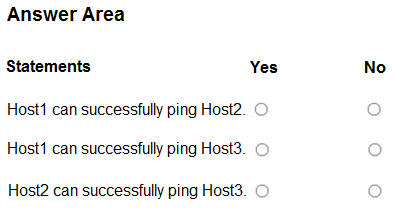
No — Host1 cannot ping Host2 because VNet2-to-VNet1 peering blocks the return path; No — Host1 cannot ping Host3 because peering is non-transitive and no router forwards via VNet2; Yes — Host2 can ping Host3 over the direct VNet2-to-VNet3 peering.
Question
You have an Azure subscription that contains an Azure Virtual Desktop deployment. The subscription contains the virtual networks shown in the following table.
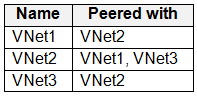
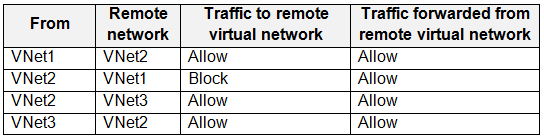
You have virtual network peering configured as shown in the following table.
The deployment contains the session hosts shown in the following table.
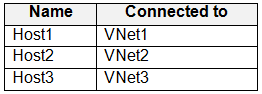
Windows Defender Firewall is configured on each session host to allow all network traffic between the session hosts.
For each of the following statements, select Yes if the statement is true. Otherwise, select No.
NOTE: Each correct selection is worth one point.
Key Takeaways
It tests directional VNet peering and non-transitivity; the trap is treating forwarded traffic or host firewall allow rules as transitive routing.
This AZ-140 hotspot tests whether AVD session hosts in peered virtual networks can ping each other. The verdict is No, No, Yes: Host1 cannot reach Host2 or Host3, while Host2 can reach Host3.
Common mistake: Assuming VNet peering is transitive or that opening all traffic on the session-host firewall guarantees connectivity; the return path and missing direct peer route still block the ping.
Expert Analysis
Peering is evaluated one direction at a time
The decisive rule is that an Azure VNet peering link is not a single bidirectional permission. Each peering resource has its own allow virtual network access behavior, and a path works only when the relevant direction is allowed. In this scenario, Host1 sits in VNet1 and Host2 in VNet2; VNet1 to VNet2 is allowed, but VNet2 to VNet1 is blocked. The echo request can leave Host1, yet the echo reply from Host2 is traffic from VNet2 to VNet1 and is blocked. The session-host firewall that allows all traffic cannot fix this, because the packet is dropped by peering routing before Windows Defender Firewall matters. So Host1 cannot ping Host2.
Forwarded traffic is not transitive routing
Host1 cannot ping Host3 either. There is no direct VNet1 to VNet3 peering, and Azure VNet peering is non-transitive. A packet from Host1 would have to be routed by VNet2 toward VNet3, but a peered VNet is not a router. The allow forwarded traffic option applies to traffic that a VM or appliance in the local VNet forwards to the peer; it does not create a route between two peerings. A route server, NVA, or VNet gateway is needed for that path. Comments in the discussion make the same distinction: forwarded traffic is not the same as forwarding or routing between peers, and the missing direct peering is why the middle-host path fails.
Only the direct peered path succeeds
Host2 and Host3 are in VNet2 and VNet3, which have direct peering in both directions. With the session-host firewalls open, Host2 can ping Host3. The final selections are therefore No for Host1 to Host2, No for Host1 to Host3, and Yes for Host2 to Host3. Do not let the stateful behavior of NSGs confuse the issue; the blocking setting here is the peering permission, not an NSG rule.
Official Reference
- https://learn.microsoft.com/en-us/azure/virtual-network/virtual-network-peering-overview
- https://learn.microsoft.com/en-us/azure/virtual-network/virtual-network-manage-peering
These links open the official vendor documentation in a new tab.
Exam Strategy
Treat every peering hotspot as a path-tracing exercise. Label each host with its VNet, then check whether a direct peering exists and whether both directions permit traffic; for a middle VNet, look for an NVA, route server, or gateway before assuming transit. Ignore host firewall allow rules until the Azure path is proven, and remember that return traffic needs its own permitted direction. This method quickly yields the No, No, Yes pattern on AZ-140 peering questions.
Frequently Asked Questions
Why can't Host1 ping Host2 when the VNet1-to-VNet2 peering allows traffic?
Does Allow forwarded traffic make VNet2 route traffic between VNet1 and VNet3?
Does the Windows Defender Firewall allow-all rule change the result?
Discussion 12 contributions
Compiled from public community threads and reader submissions, lightly edited for clarity. Handles and vote tallies are shown as recorded, and comments reflect the views of individual contributors.
From public community threads 12
-
jeff1988 👍 5Host1 can successfully ping Host2: VNet1 to VNet2: Traffic to remote virtual network is allowed. VNet2 to VNet1: Traffic to remote virtual network is blocked. Conclusion: No, Host1 cannot successfully ping Host2 because traffic from VNet2 to VNet1 is blocked. Host1 can successfully ping Host3: VNet1 to VNet2: Traffic to remote virtual network is allowed. VNet2 to VNet3: Traffic to remote virtual network is allowed. Conclusion: Yes, Host1 can successfully ping Host3 because traffic is allowed from VNet1 to VNet2 and from VNet2 to VNet3. Host2 can successfully ping Host3: VNet2 to VNet3: Traffic to remote virtual network is allowed. VNet3 to VNet2: Traffic to remote virtual network is allowed. Conclusion: Yes, Host2 can successfully ping Host3 because traffic is allowed in both directions between VNet2 and VNet3. So, the answers are: Host1 can successfully ping Host2: No Host1 can successfully ping Host3: Yes Host2 can successfully ping Host3: Yes
-
Ruslan23 👍 3Host1 can successfully ping Host2 → YES VNet peering is stateful. Traffic from VNet1 to VNet2 is allowed, and the reply traffic from VNet2 to VNet1 is automatically permitted even though outbound traffic from VNet2 to VNet1 is blocked. Host1 can successfully ping Host3 → NO VNet peering is not transitive. There is no direct peering between VNet1 and VNet3, and “Allow forwarded traffic” does not provide routing. A gateway, NVA, or Route Server would be required. Host2 can successfully ping Host3 → YES There is a direct VNet peering between VNet2 and VNet3 with traffic allowed in both directions, so communication succeeds.
-
DC095 👍 2VNET peerings are never transitive. The "allow forwarded traffic" option only applies to what address space is encompassed in the service tag for "VirtualNetwork", but not to routing. A VNET gateway, route server, or NVA would be required to make the peerings transitive. This really is more a question for the Az-700 exam and not the 140.
-
e072f83 👍 2Second should be no, because of the statement you used in question 1: "VNet2 to VNet1: Traffic to remote virtual network is blocked.". This means that the return from Host3 has to pass through vnet 2 to vnet 1, but that is blocked. So while the ping will reach host 3 it will not be able to reply due to the block from vnet 2 to vnet 1.
-
DC095 👍 2Its really kind of silly that Microsoft has never provided a better description for that option.
Show 7 more comments
-
jcirkz 👍 1The answer is NNY. There seems to be some confusion around host 1 being able to ping host 3. It can NOT because of the following reason: Host 1 (VNet1) to Host 3 (VNet3) path: Host 1's ping to Host 3 will go from VNet1 to VNet2. This is allowed by the "VNet 1 to VNet 2" peering, which allows remote traffic. The traffic then attempts to go from VNet2 to VNet3. This is allowed by the "VNet 2 to VNet 3" peering, which allows remote traffic. Return path failure: Host 3's response needs to travel back through the network. It will go from VNet3 to VNet2. This is allowed by the "VNet 3 to VNet 2" peering, which allows remote traffic. The traffic then attempts to go from VNet2 back to VNet1. This is where the connection is blocked because the "VNet 2 to VNet 1" peering is configured to block remote virtual network traffic.
-
DC095 👍 1Its not a forwarder in the sense of routing. This option is applicable to the Virtual Network service tag that you would find in NSGs. It adds the address spaces of virtual networks that are peered to the peer of a VNET to the service tag so that they are automatically allowed under the "Allow VNET inbound" NSG rule. If you want routing to be facilitated, you need a route server or NVA.
-
lolo13698 👍 1Provided answer are correct: host1 > host 2: NO, because the peering is not in both direction, then the traffic cannot come back. host1 > host 3: NO, because even if peering allows it, it miss a routing device NVA to route the traffic. host2 > host 3: YES: because of direct peering allowed in both direction.
-
Ivanvazovv 👍 1Just a minor correction - traffic is stateful but this applies on NSG level. On routing level this is not applicable and traffic will be blocked before reaching the NSG.
-
e072f83 👍 1nvm, traffic forwarded from remote network is allowed, so vnet 3 can reach vnet 1. You are correct.
-
zuzmo483 👍 1But VNET2 is with VNET3. All peers have traffic forwarder configured.
-
Harish63 👍 1Vnet 1 is not peered with vnet3 -- H1 to H3 -no ping
Reader comments & corrections
No reader corrections yet — spotted an error or have a note? Share it below.
Related Analysis
Practice All AZ-140 Questions
Access 64 questions with complete answers and detailed explanations.
View Full AZ-140 Practice Test →