Selecting ROI Category and TCO Cost Driver
Short answer
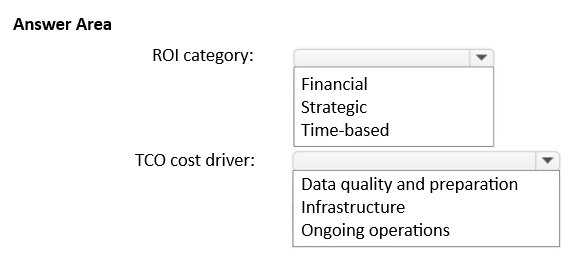
Select time savings as the ROI category and ongoing operations as the TCO cost driver for the AI claims handling solution.
Question
You have a proposal for an AI claims handling solution.
Before the proposal is approved, the solution requires a return on investment (ROI) analysis that provides early indicators of value and a complete accounting of lifecycle costs.
You need to select the ROI category and the cost driver for total cost of ownership (TCO).
What should you select? To answer, select the appropriate options in the answer area.
NOTE: Each correct selection is worth one point.
Key Takeaways
The question tests ROI category selection versus TCO cost drivers, and the trap is choosing lagging financial ROI measures plus only upfront costs, which ignore early value and lifecycle spend.
For an AI claims handling solution, the ROI category that gives early indicators of value is time savings, while the TCO cost driver covering full lifecycle costs is ongoing operations.
Common mistake: Choosing cost savings as the ROI category and initial implementation costs as the TCO driver; cost savings only appear after go-late realization, and upfront costs exclude monitoring, maintenance, support and updates.
Expert Analysis
The attractive wrong pairing Most learners reach for cost savings as the ROI category and initial implementation costs as the TCO cost driver. It sounds persuasive: ROI is normally expressed in money, and total cost of ownership is usually introduced as the price you pay to acquire and build the solution. That pairing satisfies the words "ROI" and "cost" in the prompt, and an AI claims handling proposal certainly has licensing, integration and development spend up front.
Where it stops being correct The question imposes two specific constraints, and neither constraint is met by that pairing. First, the ROI analysis must provide early indicators of value. Cost savings are a lagging, realized outcome — you cannot report them until the solution has run long enough for claims processing effort to actually drop. Time savings, by contrast, can be measured almost immediately: fewer minutes or touches per claim, faster cycle time, and shorter handling queues are leading indicators that financial benefit will follow. Time savings is therefore the ROI category to select.
Second, the TCO cost driver must give a complete accounting of lifecycle costs, not just acquisition cost. Upfront build and licensing costs ignore everything after go-live. Ongoing operations captures the recurring post-deployment spend — monitoring, maintenance, support, model tuning and solution updates — which is exactly what makes the ownership cost "total" across the solution's life.
The correct selections Select time savings as the ROI category and ongoing operations as the TCO cost driver. This pairing satisfies both halves of the requirement at once: an early value signal and full lifecycle cost coverage for the AI claims handling solution.
Exam Strategy
When a hotspot asks for two related selections, read both requirement clauses before picking anything: an "early indicator" phrase points to a measurable leading metric such as time or throughput, while "lifecycle" or "complete accounting" points to recurring post-deployment spend rather than acquisition cost. Pair each clause with exactly one selection and reject any choice that satisfies only one of them.
Frequently Asked Questions
Why is time savings preferred over cost savings as the ROI category?
What belongs in the ongoing operations TCO cost driver?
Does this ROI and TCO pairing apply beyond AI claims handling?
Discussion 1 contributions
Compiled from public community threads and reader submissions, lightly edited for clarity. Handles and vote tallies are shown as recorded, and comments reflect the views of individual contributors.
From public community threads 1
-
buraph 👍 1Time savings—such as reducing the time needed to process a claim, can provide early indicators of value before actual financial savings are measured. Ongoing operations include post-deployment costs such as monitoring, maintenance, support, and solution updates. These costs are part of the solution’s total cost over its lifecycle
Reader comments & corrections
No reader corrections yet — spotted an error or have a note? Share it below.