Configuring Switch Port Authentication Violation Replace Action
Refer to the exhibit. Network access control is implemented on the LAN and an engineer must now configure the switch port level so that users with new corporate devices can connect to the corporate LAN without issues. What must be configured next? - 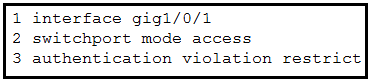
Community Votes
100% of anonymous learners picked answer D. Votes are pick records left by other test-takers — they are not the verified answer.
Community Insight
The exam tests knowledge of the 'authentication violation replace' command on access ports using 802.1X, which is the standard solution for allowing a user's device to reconnect after being moved to a new port or when credentials change.
This question tests the configuration of Cisco Identity Services Engine (ISE) and switch port security interactions, specifically how to handle authentication violations for moving devices. The correct action is setting the violation mode to 'replace' to allow seamless re-authentication.
Candidates often select 'restrict' or 'protect', which drop traffic from unauthorized devices but do not automatically clear the current session or allow the new device to authenticate without manual intervention.
Community Discussion (3 comments)
Comments & Corrections
No comments yet — spotted an error or have a note? Share it below.
Expert Analysis
Why the Answer Is Correct
The scenario describes a situation where corporate devices are failing to connect due to an authentication violation, likely because the previous session is still active or the port is in an error-disabled state. Configuring 'authentication violation replace' ensures that when a new host attempts to authenticate, the switch removes the current session and authenticates with the new host. This is critical for mobile users or devices that may have been connected to different ports previously.Why the Other Options Are Wrong
Option A ('clear port-security dynamic') clears dynamically learned MAC addresses but does not address the 802.1X authentication state. Option B ('shut and no shut') manually resets the port but is not a persistent configuration fix for ongoing issues. Option C ('errdisable recovery cause psesecure-violation') deals with port-security violations, not 802.1X authentication violations, although they can sometimes interact, 'replace' is the direct 802.1X command.Community Comment Notes
Community consensus strongly supports option D. As noted by user dfb0b7d, 'replace –Removes the current session and authenticates with the new host.' This confirms that this is the intended behavior for allowing users with new or moved devices to connect without manual port resets.Official Reference
Exam Strategy
When troubleshooting 802.1X connectivity issues on access ports, always consider the 'authentication violation' action. 'Replace' is the preferred method for environments where devices move frequently to ensure minimal disruption.
Frequently Asked Questions
What is the difference between authentication violation restrict and replace?
Restrict drops packets from unauthorized hosts and generates syslog messages, while replace removes the current authenticated session and allows the new host to authenticate immediately.
Does errdisable recovery apply to 802.1X violations?
No, errdisable recovery applies to port-security, STP, or other physical/logical errors. 802.1X violations are handled by the 'authentication violation' command.