Configuring 802.1X Authentication Violation Replace
Short answer
D Configure 'authentication violation replace' to remove the current session and authenticate with the new host.
Question
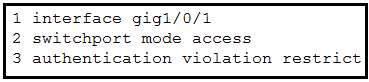
Refer to the exhibit. Network access control is implemented on the LAN and an engineer must now configure the switch port level so that users with new corporate devices can connect to the corporate LAN without issues. What must be configured next?
Key Takeaways
The exam tests knowledge of Cisco switch 802.1X violation modes, specifically distinguishing between standard port security violations and 802.1X authentication violations.
This question addresses configuring switch port-level settings for 802.1X network access control to ensure seamless connectivity for corporate devices. The correct configuration uses the 'authentication violation replace' command to handle authentication failures by replacing current sessions.
Common mistake: Candidates often select 'errdisable recovery cause psesecure-violation', confusing 802.1X authentication mechanisms with legacy port security (MAC address) configurations.
Expert Analysis
Why the Answer Is Correct
The correct answer is D because the scenario involves Network Access Control (NAC) using 802.1X. The exhibit shows a switch port configured with dot1x pae authenticator. When a new device connects, it must be authenticated. If an existing session is present or if the initial authentication fails but needs to be replaced to allow the new host, the authentication violation replace mode is used. This command removes the current session and attempts to authenticate with the new host, which is critical for ensuring users with new corporate devices can connect without manual intervention.
Why the Other Options Are Wrong
Option A (clear port-security dynamic) is related to MAC address port security, not 802.1X authentication. Option B (shut and no shut) is a manual administrative action to reset a port, not a configuration setting for handling violations automatically. Option C (errdisable recovery cause psesecure-violation) configures automatic recovery for ports disabled due to port security violations (like MAC limit exceeded), whereas this scenario requires handling 802.1X authentication events, not generic errdisable states from port security.
Community Comment Notes
Community members consistently identified D as the correct answer. As one user noted, "the command authentication violation replace the switch is going to remove the current session and authenticates with the new host." Another comment clarified that options A and C relate to port security, while the scenario explicitly mentions 802.1X, reinforcing the need for the authentication-specific violation command.
Exam Strategy
Always distinguish between Port Security (MAC-based) and 802.1X (Identity-based) commands in NAC scenarios. Look for keywords like 'dot1x' in the exhibit to trigger the correct command set, avoiding port security specific commands like 'mac-address sticky' or 'port-security'.
Frequently Asked Questions
What is the difference between 'replace' and 'restrict' in 802.1X?
Why is 'errdisable recovery' incorrect here?
Discussion 5 contributions
Compiled from public community threads and reader submissions, lightly edited for clarity. Handles and vote tallies are shown as recorded, and comments reflect the views of individual contributors.
From public community threads 5
-
XBfoundX 👍 1 Answered DThe answer is D. C is related to port security, in this case the customer is talking about 802.1x. The command errdisable recovery cause psecure-violation tells a Cisco switch to automatically re-enable a port shut down by port security. So answer is D, in this case the authentication violation restrict is going to generate a syslog message like this: 15749: Jul 7 02:19:38.884: %AUTHMGR-5-SECURITY_VIOLATION: Security violation on the interface GigabitEthernet2/0/10, new MAC address (8cec.4b23.3815) is seen.AuditSessionID Unassigned' With the command the switch is going to remove the current session and authenticates with the new host.
-
dfb0b7d 👍 1 Answered Dshutdown–Error disable the port. restrict–Generate a syslog error. protect–Drop packets from any new device that sends traffic to the port. replace –Removes the current session and authenticates with the new host.
-
Premium_Pils 👍 1 Answered Dhttps://community.cisco.com/t5/switching/802-1x-port-security-violation/td-p/3086145 https://community.cisco.com/t5/network-access-control/802-1x-authentication-issues-when-moving-between-switch-ports/td-p/2588949
-
XBfoundX 👍 1* With the command: authentication violation replace the switch is going to remove the current session and authenticates with the new host.
-
houhou12322 👍 1https://community.cisco.com/t5/switching/802-1x-authentication-violation-restrict/td-p/3412051
Reader comments & corrections
No reader corrections yet — spotted an error or have a note? Share it below.